Most people learn how to hang a hammock the way I did: two trees, a coil of rope from the hardware store, and a dip so deep that by morning their spine has memorized the shape of a banana. Then they blame the hammock.
It is almost never the hammock. It is the geometry. Hang the same fabric at the right angle with the right straps and it sleeps flat, cool, and better than a tent on a warm night. Hang it wrong and no amount of money fixes it.
I live in Asheville, North Carolina, and I have spent most of my summers hanging hammocks for other people to sleep in. Every July I run a hammock camp where more than 20 hammocks go up for a weekend, and every one of them gets the same treatment: a sag check, a fabric stretch check, and the 3 AM comfort test. If a hammock wakes me up at 3 AM, it failed, no matter what it cost.
The two hammocks in this guide cover the two jobs most people actually have. One is for the yard, where there are no trees and nobody wants to think about suspension angles. The other is for the trail, where every ounce matters and the hang is the whole point. Here is how to set up each one so it sleeps the way it should.
Why you should trust me
I have been reviewing camping gear and teaching outdoor skills for 12 years, and I have slept in more hammocks than beds. I have hung everything from cheap parachute nylon that tore on day two to full camping systems with integrated bug nets and rain flies. I measure sag, I check fabric stretch overnight, and I check strap width with a tape, because a 1-inch strap and a 2-inch strap do very different things to a tree over a decade.
My rules are simple. No recommendation without a full night's sleep in something like it. No tree-safety claim without a strap-width check. No camping claim without a rain test. I once watched a forest ranger show what thin straps do to bark over 10 years, and I have never forgotten it.
How I picked and how I tested
A hammock is not one category. It is two, and the split matters more than brand. A hammock that needs trees is a camping product. A hammock that comes with its own stand is a backyard product, and treating it like camping gear is how people end up miserable on a trip.
So I split this guide by job instead of by price. For the yard, the question is whether the stand is stable, whether the fabric holds up to a season of sun, and whether two people can actually sit in it. For camping, the questions are weight, packed size, fabric stretch, and whether the hammock can be hung at a real 30-degree angle.
The specs I look at first are the boring ones. A structural ridgeline is the cord that sets the hammock's sag, and it is the difference between sleeping flat and sleeping curved like a banana. Parachute nylon without a ridgeline is a fine backyard fabric and a miserable camping fabric. Strap width is next, because rope and thin webbing kill trees. Then suspension angle, which almost nobody gets right the first time.
The numbers I trust: a 30-degree suspension angle for sleeping, a 2-inch minimum strap width for tree safety, and about 6 inches of height difference between the head and foot end so you do not slide downhill all night. Those three numbers do more for your sleep than any upgrade you can buy.
The gear this guide is built around
Two products, two jobs. Neither one is a compromise pick for the other's job, and that is the point.
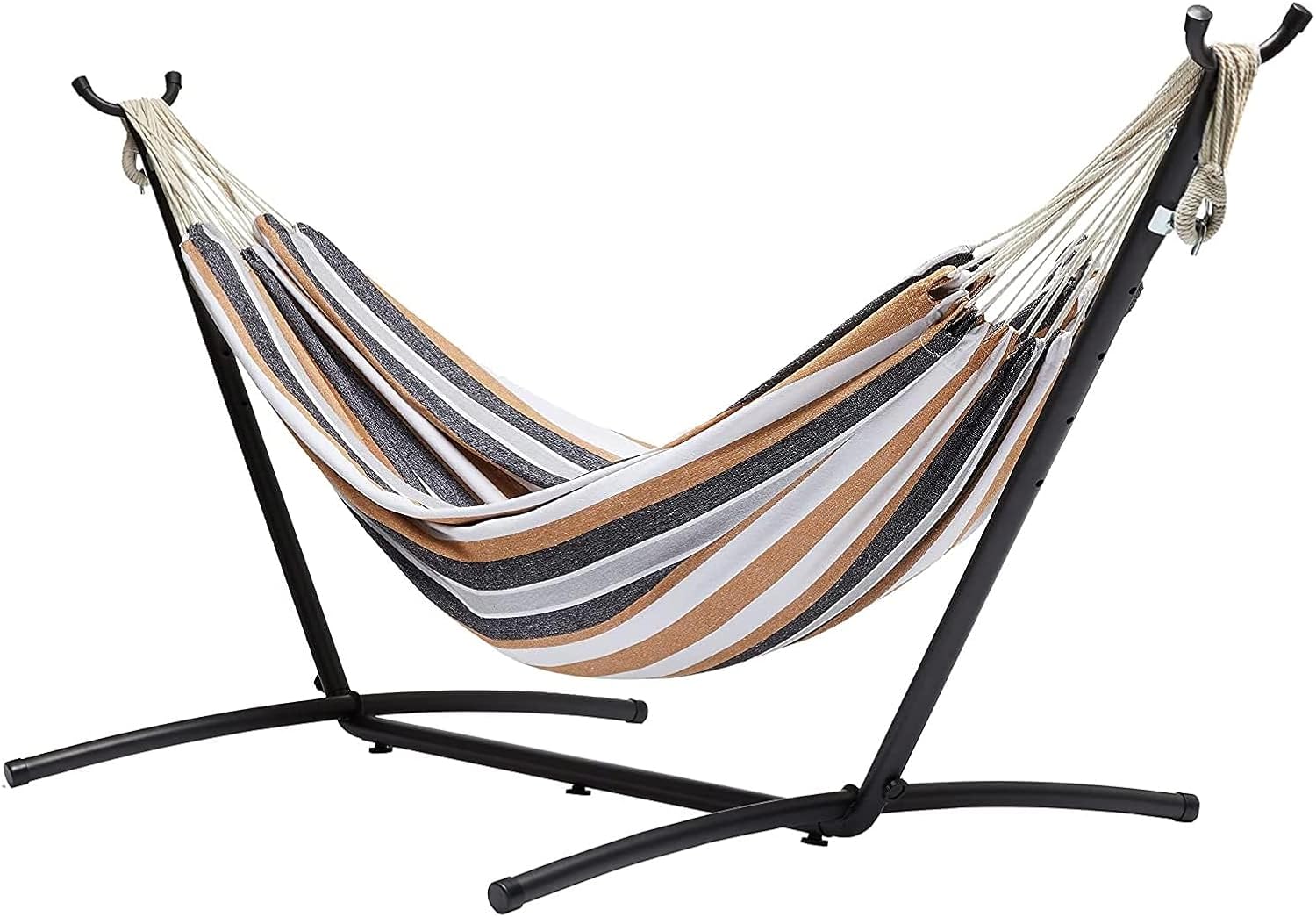
Backyard pick: Amazon Basics Double Portable Hammock with Space Saving Steel Stand and Carrying Case, 2 Person, 470lb Capacity, Multi Color, 118" x 46" x 39"
 Visit on Amazon →
This is the hammock I send people to when they have no trees, no patience, or both. The steel stand is the whole reason it exists: it removes the two-tree requirement, it sets its own suspension angle for you, and it breaks down into a carrying case so you can move it from the deck to the yard to the campsite parking lot without hunting for anchors. The listed capacity is 470 pounds, the frame footprint is 118 by 46 by 39 inches, and the hammock itself is sized for two people. Check current Amazon price.
The stand geometry is the quiet win here. Because the frame sets the hang, you never deal with the banana sag that ruins a rope-and-tree setup, and you never damage a tree. That makes it the right answer for renters, apartment dwellers, and anyone whose yard is a concrete patio. It also makes it the right answer for a guest room or a screened porch, which is where most people actually use a hammock.
Flaws but not dealbreakers: The stand is heavy, and it is not a backpacking item, so do not plan to carry it anywhere you would not carry a folding chair. The double sizing is generous for two people sitting, and snug for two people sleeping, which is normal for this category. If you want a hammock for one sleeper in the woods, this is the wrong product and the next pick is the right one.
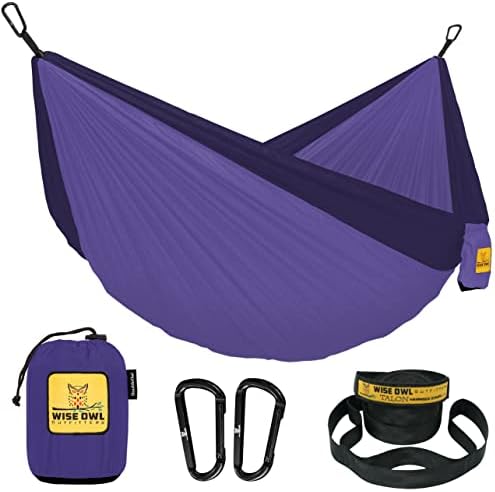
Camping pick: Wise Owl Outfitters Hammock for Camping Single Hammocks Gear for The Outdoors Backpacking Survival or Travel - Portable Lightweight Parachute Nylon SO Lt Blue & Grey
 Visit on Amazon →
This is the trail hammock. It is a single, which is the size that actually sleeps well, and it is made of parachute nylon, which packs down small and dries fast. The listing places it in the backpacking, travel, and survival categories, and that is exactly the job: something light enough to disappear into a pack and simple enough to hang in five minutes at the end of a long day. Check current Amazon price.
Two things to know before you buy it. First, parachute nylon stretches. It relaxes under your body heat over the first hour, and if you do not account for that you will wake up on the ground. Second, a bare hammock is not a sleep system. You still need wide tree straps, and for camping you need a tarp over you and insulation under you. A hammock with no bug net and no rain fly is a nice place to nap and a rough place to spend a stormy night.
Flaws but not dealbreakers: No integrated bug net, no tarp, and no structural ridgeline in the box, so the flat-sleep geometry is on you to set. If any of those three things is a dealbreaker, you are shopping for a camping system, not a hammock, and that is a different list. Also skip any suspension that ships as rope. Rope kills trees and it fails at 3 AM.
The setup, step by step
Now the part you came for. This works for any hammock with a tree-friendly suspension, and the stand version already handles the angle for you.
Step one: Choose anchors that will not fail. For a tree hang, look for two trees 12 to 15 feet apart, at least 6 inches across at chest height, alive, and with no dead limbs overhead. Dead wood is the thing that falls on you. If your yard has no trees, stop here and use a stand instead of tying off to a fence post or a railing.
Step two: Use straps, not rope. Two-inch wide webbing is the standard. Thin rope and cable cut into bark and can girdle a tree over years, and they also slip and stretch under load. This is the single most common mistake I see, and it damages something other than your sleep.
Step three: Set a 30-degree angle. When the hammock is loaded, the suspension should rise at roughly 30 degrees from horizontal. It looks shallower than you expect. Hung tight and flat, a hammock feels unstable and dumps you sideways. Hung at 30 degrees, it sits lower and wider and sleeps flat.
Step four: Raise the foot end. Hang the foot end about 6 inches higher than the head end. It sounds like a small thing, and it is the difference between staying in place and sliding toward the middle all night.
Step five: Lie on the diagonal. In a single hammock, your body should run corner to corner, not straight down the centerline. That diagonal is what lets you lie flat instead of curling.
Step six: Add a structural ridgeline for camping. A ridgeline is a fixed cord running from one end of the hammock to the other. It locks the sag so the hang is identical every time, and it lets you set a flatter lay without fighting the fabric.
Step seven: Re-tighten after 20 minutes. Parachute nylon relaxes under body heat and weight. Sit in the hammock, give it 20 minutes, and check the angle again. If the bottom is closer to the ground than it was, you were hung too shallow to begin with.
Step eight: Build the system around it. For camping, that means a tarp pitched above, a bug net if bugs are real where you are, and insulation underneath. Below roughly 65 degrees Fahrenheit, a sleeping bag does nothing for your back because the fill compresses under you. You need a pad or an underquilt.
Mistakes that ruin a hang
The list is short and it repeats.
Rope instead of straps. Every time. It is included in the box because it is cheap, and it is the first thing to throw away.
A hammock hung like a banana. If your body curves, the sag is wrong, not the fabric. Move the straps up the tree and widen the angle.
Hanging too high. Sit in the hammock before you commit. If your feet dangle well off the ground, you are too high, and getting in will be an adventure.
Bug nets that only zip from the inside. Great until you need to get out at 3 AM.
Double hammocks sized for one adult. If two people are sleeping in a hammock, they had better like each other, and they had better be small.
No tarp on a camping trip. A hammock without a rain fly is a fair-weather bed. The rain test is not optional if you plan to sleep outside.
What this all costs
I do not quote prices here because they move, and a stale number is worse than no number. Check current Amazon price on each listing before you buy, and do the math on the whole system instead of the hammock alone.
The yard setup is one purchase: hammock, stand, and carrying case in one box, and nothing else to buy. The camping setup is a hammock plus straps, plus a tarp, plus bottom insulation, plus a bug net if you need one. The hammock is the cheapest part of that list, and the straps are the part people skip.
Either way, the money is not the hard part. The 20 minutes you spend getting the angle right is what separates a hammock you use twice from a hammock you use every week. Hang it at 30 degrees, use wide straps, raise the foot end, and let the geometry do the work.
That is the job. Sleep flat, sleep through the night, and let the 3 AM test settle it.