Walk past any backyard on a Saturday afternoon and you will find the same hammock: strung drum tight between two trees, hanging dead flat, waiting to dump its first occupant onto the grass. That hammock is not broken. It is hung wrong.
I have slept in more hammocks than beds. Twelve years of reviewing camping gear from Asheville, North Carolina, and a summer hammock camp where I hang more than 20 hammocks in a weekend, taught me that learning how to hang a hammock properly is 90 percent geometry and 10 percent gear. The fabric matters. The bug net matters. The straps matter more than both. But none of it saves you if the angle is wrong, because a hammock hung at the wrong angle is just a banana with a zipper.
This is the whole process, start to finish: the three numbers that decide whether you sleep or fight the fabric, two hammocks that cover the backyard and the backcountry, and the eight steps I run every single time I hang.
Why you should trust me
I have been reviewing camping gear and teaching outdoor skills for 12 years, and I live in one of the better hammock towns in the country. Every summer I run a hammock camp where 20 plus hammocks go up for a weekend, and I pay attention to the things that show up at 3 AM: sag that drifts overnight, fabric that stretches where your hips sat, straps that creep down the bark, and bug nets that turn out to be a trap instead of a shelter. That last one is why I started calling it the 3 AM comfort test. If you are still asleep at 3 AM, the hang is right. If you are awake and adjusting, it is not.
I hold three rules before I recommend anything. No recommendation without a full night in it. No tree safe claim without a strap width check. No camping claim without a rain test. If I tell you a hammock works, it cleared those three, not a spec sheet.
The three numbers that decide your night
Before gear, geometry. Three numbers do most of the work, and none of them cost anything.
Thirty degrees. That is the angle of the suspension from horizontal, and it is the difference between lying flat and curling up like a shrimp. A hammock hung at roughly 30 degrees has a gentle curve that you lie across diagonally, which flattens your body from shoulders to hips. A hammock hung tight at 5 degrees has nowhere to put your shoulders, so they ride up and the fabric pinches. Here is the field trick I use when I do not want to pull out a phone: make a finger gun, thumb up and index finger out, and match the suspension to that angle. It is not precise. It is close enough to sleep on.
The ridgeline. A structural ridgeline is a cord running from one end of the hammock to the other, set slightly shorter than the hammock itself. It locks the sag, which means you get the same hang whether your trees are 12 feet apart or 16 feet apart. This is the single change that turns a backyard hammock into a camping hammock, and it is the first thing I look for when someone asks me why their hammock sleeps differently in every campsite.
The foot end. Raise it. Roughly six inches higher than the head end is the usual starting point. Your center of gravity sits higher in your torso than in your legs, so a perfectly level hang slides you toward the foot end all night and you wake up folded into the corner. Raising the foot end keeps you where you put yourself.
Get those three right and almost any hammock with sound fabric will sleep. Get them wrong and no amount of money fixes it.
How I chose these two hammocks
Two hammocks cover almost every version of this question. One is for people with trees and ambitions of sleeping outside. One is for people with a patio, a driveway, or a rental where you cannot put a strap around anything.
I looked at four things: whether the hammock sleeps flat at a 30 degree hang, whether the suspension is wide enough to be safe for bark, whether the fabric holds its shape overnight, and whether the bug and rain protection is integrated or bolted on as an afterthought. Both of these cleared the bar for their category, and they are the two I would hand to a friend on a Friday.
The two hammocks worth hanging
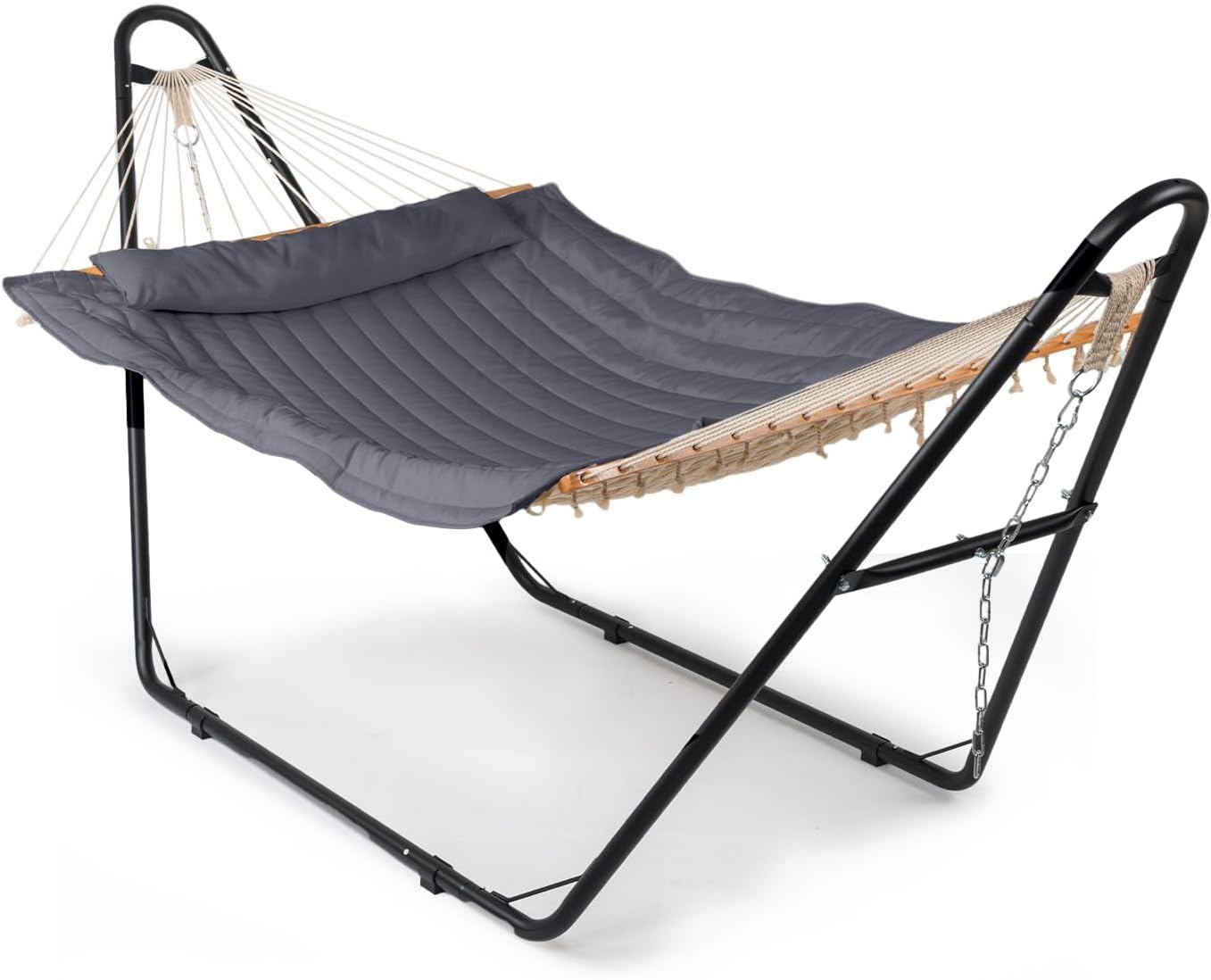
The no trees pick: Bonnlo Upgrade 440LBS Hammock with Stand, Grey
 Visit on Amazon →
Not every hammock problem is a tree problem. If you have a balcony, a small yard, a rental with no branches worth trusting, or a partner who is not walking into the woods, a hammock with a stand solves the geometry for you: the frame sets the distance and the height, so you dial in the hang once and leave it. The Bonnlo is rated to 440 pounds, which is more than most two person camping hammocks carry, and the grey fabric reads as patio furniture instead of a circus tent, which matters if this is going to live in view of the house. It also means you can hang on concrete, decking, or a campsite where the only trees are the ones you would not trust with your weight.
What it will not do is go in a pack. A stand hammock is furniture, not a sleep system, and it stays where you put it. Check current Amazon price.
Flaws but not dealbreakers: a frame does not teach you the 30 degree hang the way trees do, because the stand makes the decision for you. You still want to check the angle on the first setup and adjust the hammock body if it looks flat. Also, on a windy day a stand hammock acts like a sail, so bring it in or take the body down if a storm is coming.
Anyone with a yard, a deck, or a covered porch who wants to be in a hammock this afternoon should start here.
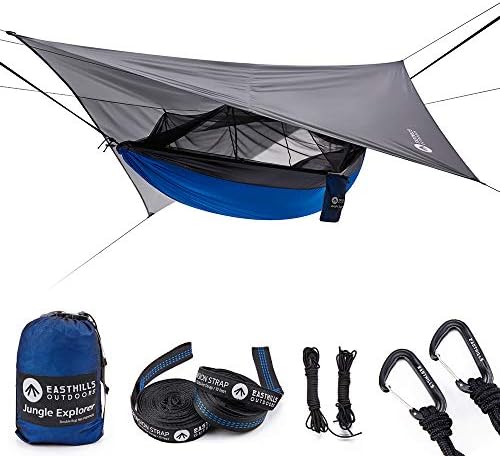
The camping pick: Easthills Outdoors Jungle Explorer 118" x 79" Double Camping Hammock Lightweight Rip-Stop Parachute Nylon 2 Person Hammocks with Removable Bug Net, Tree Straps and Tarp Blue
 Visit on Amazon →
For actual camping, you need three things in one bag: a hammock, a bug net, and a rain tarp. The Easthills Jungle Explorer ships with all three plus tree straps, which is exactly why I point beginners at it. The body is 118 by 79 inches in rip-stop parachute nylon, which makes it a genuine two person size rather than one of those double hammocks that turn out to be sized for one adult and a backpack. The bug net is removable, and that detail matters more than people expect: in black fly season you want it on, and on a clear October night you want it off and out of your face. The tarp covers the hammock, and the straps are in the box, so you are not improvising suspension out of whatever rope is at the campsite. Check current Amazon price.
The one thing to understand before you buy: 79 inches of width is comfortable for two people who like each other and are not trying to sleep through a storm. If you are solo, that extra fabric is just more material to manage and it will billow in wind. It is still the right pick for couples and for anyone who wants the option of sharing.
Flaws but not dealbreakers: an integrated system means you accept the tarp that comes with it rather than choosing your own. For three season camping that is fine. For a week of sideways rain you will eventually want a larger fly with more coverage, and that is a next summer problem, not a this weekend problem.
Anyone sleeping outside, in any season where bugs exist, gets the most out of this one.
How to hang a hammock properly, step by step
Here is the whole routine. It takes about 15 minutes the first time and three minutes after that.
Step one: choose your trees. Two live trees, roughly 12 to 15 feet apart, each six inches or more across. Look up before you look sideways. Dead branches are the real danger in hammock camping, not the hammock, and no suspension saves you from a widowmaker. If the only trees available are thin or half dead, go to the stand hammock instead. It is not a compromise. It is the correct call.
Step two: set the straps at chest height. Start both straps around chest height and adjust from there. They need to be wide, two inches minimum, so the load spreads across the bark instead of cutting into it. Rope is not a suspension. Rope damages the tree, slips when the bark is wet, and fails at the worst possible hour. If a hammock ships with rope in the box, buy straps and leave the rope at home.
Step three: clip in and check the angle. Step back and look at the suspension. That finger gun angle, roughly 30 degrees, is the target. If the line from tree to hammock looks straight, your straps are too high or your trees are too far apart. Move the straps down or find closer trees. This is the step people skip, and it is the one that decides the night.
Step four: raise the foot end. Once the angle is right, lift the foot end strap until that end hangs about six inches higher than the head end. Stand back and confirm. It will look slightly wrong, and it is correct.
Step five: add a structural ridgeline if you are camping. Run a cord from one end of the hammock to the other, set slightly shorter than the hammock body. Now the hang repeats no matter what trees you find, which is the whole point. On a backyard hammock this is optional. On a camping hammock it is the difference between a good night and a guessing game.
Step six: lie diagonally. Get in and lie across the centerline, not along it, so your shoulders land on one side of the fabric and your hips on the other. That diagonal is how a 30 degree hang sleeps flat. If you lie straight down the middle you will feel the banana curve even when the angle is perfect.
Step seven: bug net and tarp, in that order. Clip the net on before you get in, and check which side the zipper opens from. A net that only opens from the inside is a trap, and I have watched grown adults negotiate with one at 2 AM. Then hang the tarp high enough that it does not touch the hammock and low enough that wind driven rain cannot come in sideways. If the tarp presses on the bug net, condensation will find you by morning.
Step eight: run the 3 AM check before you commit. Three quick tests. Sit in the hammock, stand up, and look at the fabric where your weight was. If it stays stretched out and baggy, that fabric is going to sag by morning, so tighten the hang slightly to compensate. Push the hammock sideways and watch the straps to see whether they creep down the tree. Then get in, zip up, and lie there in the dark for five minutes. If you are already adjusting your position, get out and fix the angle now, while you still have light and patience.
The mistakes that ruin a night
- Rope suspension. It kills trees and it fails. Wide straps or nothing.
- Hanging too tight. A flat hammock is a display piece. Thirty degrees or you will feel every hour of the night.
- Hanging too low. If you are camping with a tarp, the hammock needs room to move without pressing into the fly. Sit height, not ground height.
- A bug net that only zips from the inside. Check this before you hang it, not after.
- Trusting a double that is sized for one. Width is the spec that matters for two people, not the word double on the box.
- Skipping the tarp on a clear forecast. Forecasts change at 1 AM. The tarp weighs almost nothing and it is already in the bag.
- Hanging in the same two trees every weekend. Bark compresses. Rotate your trees and give the ones you love a season off.
What this costs and whether it is worth it
I do not print prices in this guide because they move with the season and the seller. Both listings above say Check current Amazon price, and that is the number to trust on the day you buy.
Do the math in nights instead. A hammock you use 40 nights a summer costs you pennies a night by the second season, and the stand version replaces a patio chair you were going to buy anyway. The camping version replaces a tent for one or two people, plus the flat ground you were hoping to find. The other cost is the one people ignore: the suspension. If a hammock ships with rope, you are buying straps anyway, so budget for two inch straps from the start and protect the trees you are hanging from. That is the cheapest insurance in camping.
The short version
If you have trees, take the camping hammock, add a structural ridgeline, hang at 30 degrees, and raise the foot end. If you do not have trees, take the hammock with the stand and enjoy the fact that setup takes two minutes. Either way the routine is identical: straps wide, angle 30, foot end up, lie diagonal, net before tarp, and test the whole thing before you commit to sleep.
The best hammock is the one that makes you cancel your afternoon plans. The second best is the one that is still comfortable at 3 AM. The gap between them is about 15 minutes of setup, done once, correctly, on the first try.