Most hammock problems are not hammock problems. They are geometry problems. I have watched a dozen people at my summer hammock camp tie a brand new hammock between two trees, climb in, and instantly turn into a banana, then blame the fabric. The fabric was fine. The hang was wrong.
Learning how to hang a hammock is a fifteen minute skill that pays off every single time you use one. Get the sag right, use straps instead of rope, and a cheap hammock out-comforts an expensive one hung badly.
This guide covers the two situations I get asked about most: the backyard with no usable trees, and the porch or bedroom where you want a seat rather than a bed. Same rules underneath, different anchors.
Why you should trust me
I have been reviewing camping and hammock gear for 12 years, most of it from Asheville, where the trees grow close together and the rain is not negotiable. Every summer I run a hammock camp in western North Carolina where I hang 20-plus hammocks for a weekend and run the same three checks on every one of them: sag angle, overnight fabric stretch, and the 3 AM comfort test, which is exactly what it sounds like. A hammock that feels wonderful at 9 PM and miserable at 3 AM does not get a recommendation from me.
I also spent years hanging alongside a forest ranger who showed me what a decade of thin cord does to the layer of living tissue just under a tree's bark. That is why the strap conversation in this guide is not a footnote. It is a step.
How I picked and how I tested
This is a how-to guide, not a shootout, so I am only pointing you at two pieces of gear: one complete backyard setup and one hanging chair. Both had to pass the same filters before they earned a spot here.
For the stand kit, I looked at whether the frame stays stable under a real two-person load, whether the hardware seats without wobble, whether the stand folds down small enough to live in a garage corner, and whether the included hammock is one you would actually leave hanging. For the chair swing, I looked at the spreader bar first, because a chair without a rigid bar collapses into a cocoon the second you sit down, then the load rating, then whether the size range lets you match the chair to a narrow bedroom or a wide porch.
What I do not do is guess. I do not recommend a hammock I have not hung, and I do not call a suspension tree-safe unless the straps are wide enough to deserve the word. If a claim in this article is not something I can check with my hands on the fabric, it is not in the article.
One more thing about the testing: the numbers that matter in a hammock are few. A 30-degree hang angle is the difference between flat and folded. Two-inch straps are the difference between a tree that survives and a tree that does not. Everything else, color, brand, price, is a preference.
The two setups worth buying before you hang anything
You need something to hang from and something to hang. If you have two trees at a reasonable distance, your shopping list is a hammock and a pair of straps. If you do not, you need a frame, and if you want a seat instead of a bed, you want a chair swing with a rigid bar. Here is what I would start with in each case.
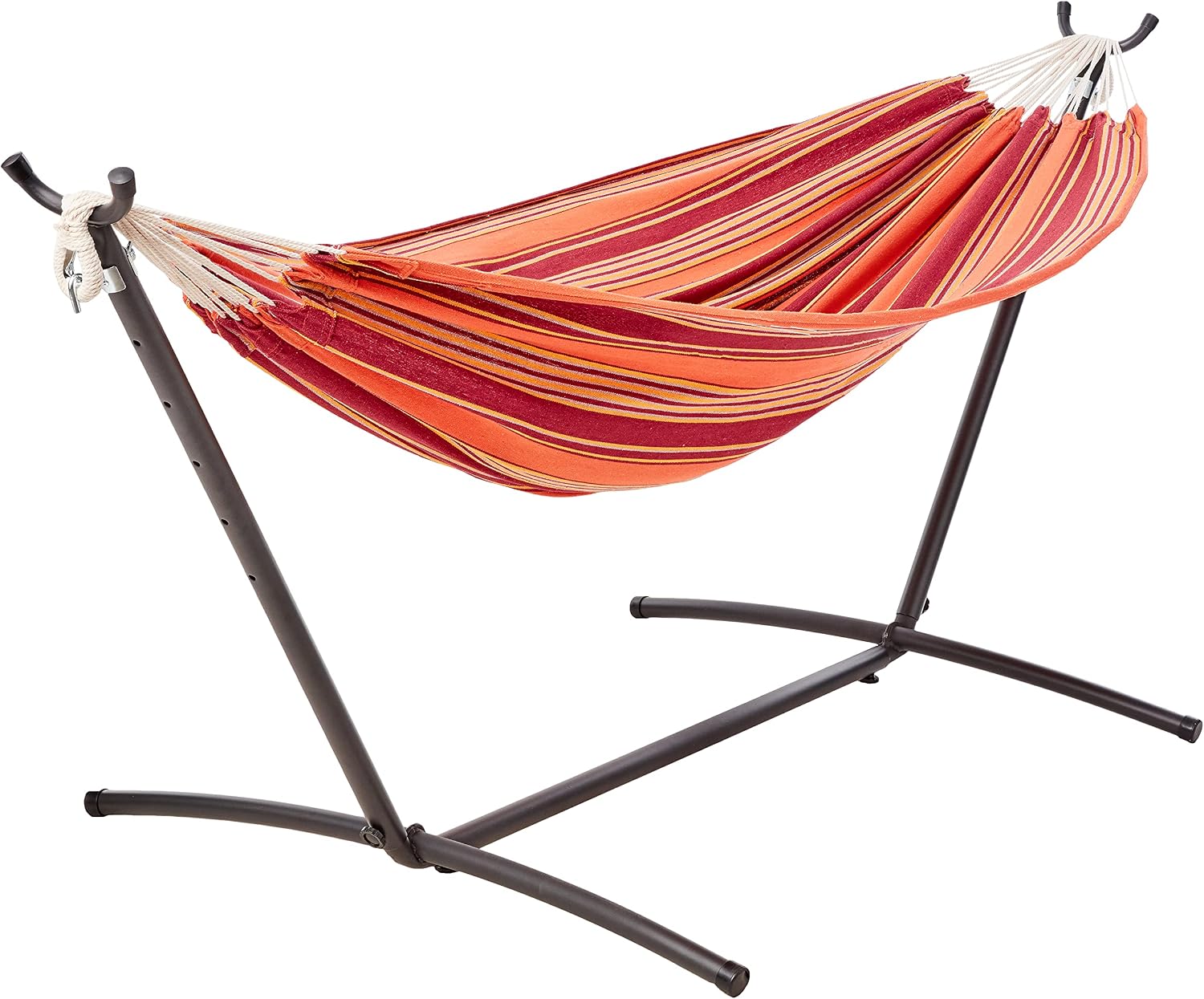
Best for the backyard: Amazon Basics Double Hammock with 9-Foot Space Saving Steel Stand and Carrying Case, 2 Person, 450 lb Capacity, Sunset Orange Stripe
 Visit on Amazon →
This is the setup I point first-time hammock owners toward, because it removes the two variables that ruin most first hangs: no trees, and a hammock hung too tight. The steel stand spans a fixed distance, so you are not guessing at anchor spacing, and the frame folds down into a carrying case when the season ends. The 450 pound capacity and 2 person rating mean it is built to hold two adults sitting up and talking, not just one person napping.
The hammock itself is a double, and a double is a couch more than a bed. That is not a knock. For backyard reading, an afternoon nap, or two kids who cannot agree on anything, a wide double with plenty of sag is exactly right. Lie on the diagonal, corner to corner, and you will sleep flat instead of curled.
Flaws but not dealbreakers: A stand needs level ground. Set it on a slope and you will feel the whole frame shift the moment you put weight in it, and the sway will follow you all night. Find the flattest patch you have, or dig out the high side.
Also check the frame hardware at the start of every season. Bolts that were tight in June have a way of loosening by October, and a stand that walks itself apart is a stand that dumps you on the grass. Two minutes with a wrench, once a year.
If you already own a camping hammock and just want the frame, you can hang your own single between the same posts. A single hung with the right sag sleeps flatter than any double, because there is no extra fabric to bunch up around your shoulders.
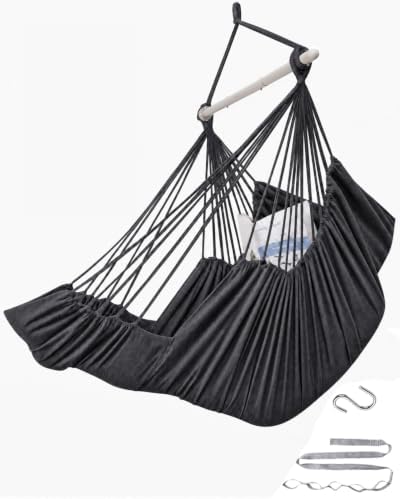
Best for the porch or bedroom: ADVOKAIR Hammock Chair Swing 500lbs Steel Bar Multi-Size Bedroom&Porch
 Visit on Amazon →
A hanging chair is a different animal from a hammock, and the steel bar is the reason. That bar holds the fabric open into an actual seat, so you sit upright with your back supported instead of sinking into a fabric taco. The 500 pound rating gives you real headroom for two people sharing it, or one person plus a dog, which is how most porch chairs actually get used.
The multi-size option matters more than it sounds. Chair swings fail indoors for one boring reason: they are too big for the room, or the seat hangs so low that your feet drag. Measure the space you have, then match the size to it rather than buying the biggest one and hoping.
Flaws but not dealbreakers: The chair is only as good as what you hang it from. A porch beam or an exposed ceiling joist is ideal. Drywall, a railing, or a decorative trim board is not, and no load rating on the chair changes that. If you cannot find a structural member, do not hang the chair until you have one.
Height matters too. Hang it high enough that the seat clears the floor with room to spare, then sit and check where your feet land. A chair that skims the ground looks fine in photos and feels wrong every single time.
The actual hang, step by step
Now the part you came for. This works on trees, on a stand, and on a porch beam.
Step one: pick your anchors. Two trees, roughly 12 to 15 feet apart, both at least 6 inches in diameter. Skip dead trees, skip anything with cracked bark, and skip the one that leans over your car. On a stand, your anchors are the posts. On a porch, it is a structural beam and nothing else.
Step two: set the sag at 30 degrees. This is the whole ballgame. The suspension line should drop at roughly 30 degrees from horizontal, which looks looser than most people expect. Tighten a hammock until the line is nearly flat and you have built a banana. Let it out until it looks like a smile and you are close.
Step three: lie on the diagonal. In a gathered-end hammock, you do not sleep along the center line. You lie corner to corner, which flattens the fabric under your body and lets you stretch out. This one habit fixes more comfort complaints than any upgrade.
Step four: straps, not rope. Use wide tree straps, 2 inches is the standard, and never rope or cord around a trunk. Rope concentrates the entire load into a thin band that cuts into the bark and the living tissue beneath it. Straps spread that load out. They also hold better, which matters at 3 AM when the alternative is a sudden drop.
Step five: hang the chair swing to clear the floor. For a chair, the geometry is simpler: bar level, seat off the ground, feet supported. Sit in it before you commit to the height. If your knees are higher than your hips, the chair is hung too low.
Step six: test it low and close to the ground first. Sit down gently, then lean back, then shift your weight side to side. Listen for creaks and watch for hardware rotating. Do this on the first hang of the season, not the night you plan to sleep out.
Step seven: add the camping layers only if you are camping. For a backyard hang, you are done. For an overnight, a rain fly over the top and a bug net around you are not accessories, they are the difference between sleeping and surviving. A hammock under a tarp with a net is a sleep system. A hammock alone in July is a mosquito buffet.
The competition and why it lost
There are a few hammock categories I deliberately left out of this guide, and you should know why.
Rope-in-the-box hammocks lost immediately. Any product that ships with thin cord for tree suspension is telling you it was designed for a photo, not for a tree. Swap the rope for straps or walk away.
Bare hammock chairs without a spreader bar lost too. Without a rigid bar, the fabric wraps around your shoulders and you end up sitting in a pouch with your arms pinned. The bar is what makes a chair a chair.
Bare doubles hung between two trees also lost, but only for this article. A double is a great backyard object, and if you have the trees, buying the hammock alone is cheaper than buying a stand. It just does not solve the problem this guide is about, which is what to do when the trees are not there.
And any hammock that sags like a banana no matter how you hang it lost for good. Some fabrics stretch overnight and never recover. That is a fabric problem, not a geometry problem, and no amount of adjusting will fix it.
What this all costs
Both of these setups are a single purchase, and that is the point of recommending them. You buy the stand kit once, or the chair swing once, and the recurring cost is zero. No straps to replace unless you go the tree route, no hardware to upgrade unless something works loose.
If you do go the tree route, budget for the straps separately and buy wide ones. Two-inch straps cost less than a ruined tree and far less than a torn hammock, and they last for years.
The cost-per-day math is easy. A stand kit that gets used every weekend from April through October spreads itself across a lot of afternoons. Divide it by five years of naps and the number gets small fast. What you should not do is buy a cheap frame that wobbles, because a wobbly stand gets used twice and then lives in the garage.
Check current Amazon price on both of the setups above and compare them against what a set of wide straps would cost you if you already have trees. For most people, that is the entire decision.
The rest is geometry, and geometry is free. Set the 30-degree sag, lie on the diagonal, check the straps, and let the afternoon go. That is the job.