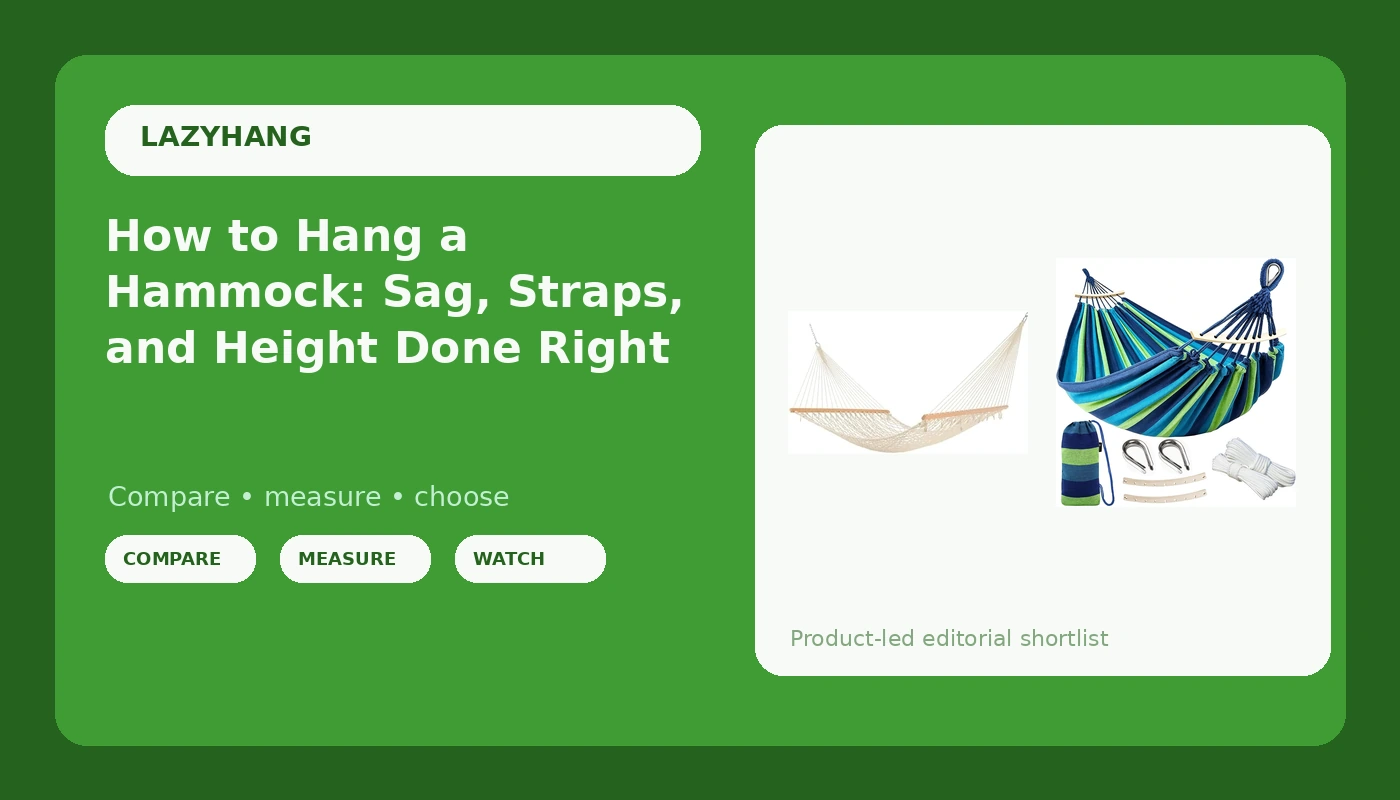
Most hammocks fail for a boring reason. Not the fabric, not the brand, not the price tag. The hang. Learning how to hang a hammock is a geometry problem long before it becomes a gear problem, and the same cotton hammock hung at 20 degrees and then at 40 degrees will give you two completely different nights of sleep. One is a hammock. The other is a banana with a person folded inside it.
I'm Marcus. I've spent 12 years hanging hammocks in western North Carolina, and every summer I run a hammock camp where 20-plus hammocks go up for a weekend while I measure sag, fabric stretch, and what I call the 3 AM comfort test. The pattern never changes: people blame the hammock when the real problem is the angle, the strap, or the height. Fix those three and a cheap hammock can out-sleep an expensive system that was strung up wrong.
The whole process takes about 10 minutes. You need two trees, one measurement, and the habit of checking your work before you commit to a nap.
Why you should trust me
I've been a camping gear reviewer and outdoor educator for 12 years, which means I've slept in more hammocks than beds. I've hung $15 parachute nylon that tore on day two and $300 camping systems with bug nets and rain flies, and the differences that actually matter are almost never the ones printed on the box.
My rules are simple. No hammock gets a recommendation from me without a full night in it. No tree-safe claim gets made without checking strap width, because a 1-inch strap and a 2-inch strap do very different things to bark over a decade. And no camping claim gets made without a rain test. What follows is the hanging process I use at camp, in that order, before a single nap happens.
How I picked and how I tested
This is a how-to guide, not a shootout, so the bar is lower and narrower: which hammocks hang well and forgive a beginner's mistakes.
I judge a hammock on four things. First, does it sleep flat at a 30-degree hang, or does it force you into a curve no matter what you do? Second, does the suspension protect the tree, or does it come with rope that will girdle bark and slip at 3 AM? Third, does the fabric stretch out overnight and leave you sitting on the ground by morning? Fourth, how does it handle spreader-bar geometry if it has bars at all, because bars change the hang completely.
For this guide I kept two very different hammocks. One is a spreader-bar camping hammock that lies flat and packs down. The other is a 13-foot woven cotton rope hammock that is exactly what people picture when they think about a backyard nap. Both hang well. They do not hang the same way, and that is the whole point.
Gear you'll need before you hang anything
Three things beyond the hammock: a suspension wide enough to be tree-safe, an anchor point you can inspect, and a realistic idea of how much your fabric will stretch. Everything else is comfort.
Skip any hammock that ships with rope as its main suspension. Rope concentrates load into a thin line, damages bark, and slips when it is wet. Two-inch webbing straps spread the load and hold. If a hammock includes chains and hooks instead of straps, that is fine for two backyard trees you own and check regularly, and it is not what I would carry into the woods.
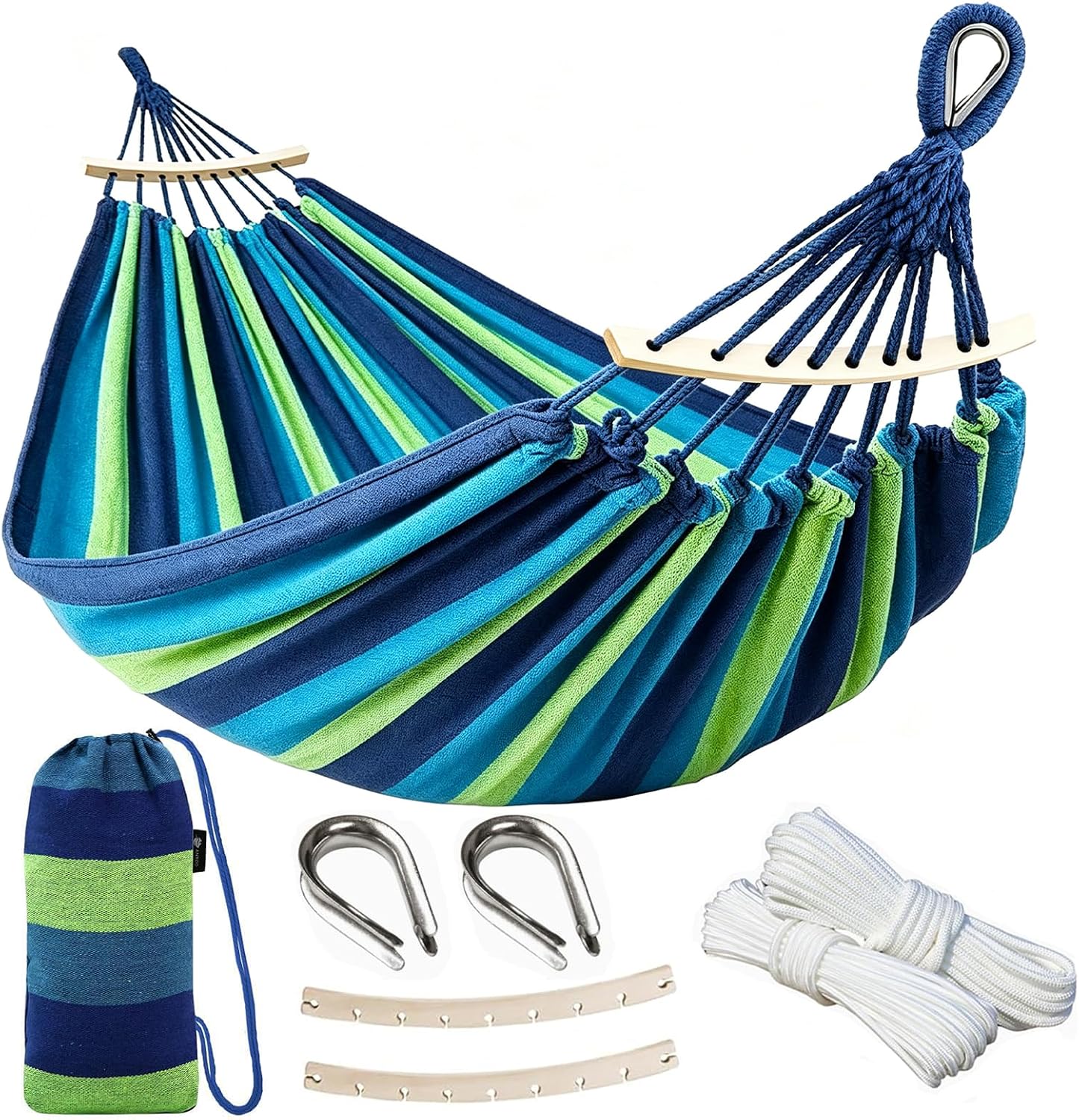
For a flat lay: 275x155cm Camping Hammock Outdoor - Portable Hammock with Detachable Spreader Bars, Comfortable Cotton Fabric Hammock with 2 Sturdy Metal Knot for Garden,Patio,Backyard, 660 lb Load Capacity
 Visit on Amazon →
Check current Amazon price. This is the hammock to look at when someone tells you they can't get comfortable in a hammock, because the detachable spreader bars hold the fabric open. You lie flat instead of being wrapped into a tube, and the cotton fabric feels closer to a bed than parachute nylon does. The bars come off for packing, and the two metal knots are the anchor points where your suspension attaches.
The catch with spreader bars is that the hang changes. You do not want a deep 30-degree sag here, because bars that tilt dump you into the middle. Keep the bars roughly level, hang the hammock flatter than you would a gathered-end camping hammock, and set the anchors so the bars sit parallel to the ground once you are in it.
Flaws but not dealbreakers: Spreader-bar hammocks are less forgiving of a sloppy hang, and they weigh more than a gathered-end camping hammock. That is the trade for lying flat.
Anyone who wants a patio or backyard hammock that feels flat and stable, and who does not want to learn a diagonal lie, will get along with this one.
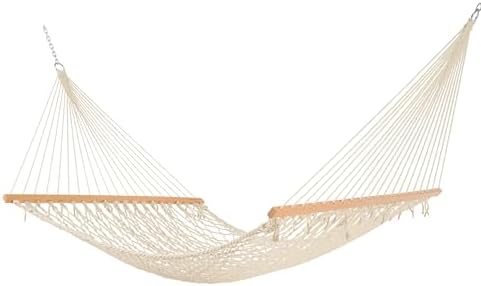
For the classic backyard hang: Castaway Living 13 ft. Double Traditional Hand Woven Cotton Rope Hammock, 2-Person, 450 lb Capacity, Free Extension Chains & Tree Hooks, Designed in the USA
 Visit on Amazon →
Check current Amazon price. Thirteen feet of hand woven cotton rope, rated to 450 pounds for two people, and it arrives with extension chains and tree hooks so you are not hunting for hardware on a Saturday morning. This is the hammock for the two trees in the yard and an afternoon that quietly disappears.
Two things to know before you hang it. First, cotton rope stretches, especially in humidity, so plan on re-tightening after the first hour and again the next morning. Second, chains and hooks are convenient and they are not tree protection. Wrap the trunk with a wide strap or a protective pad before you hook anything to it, and inspect the hardware every season for wear.
Flaws but not dealbreakers: A 13-foot hammock needs a wider gap between trees than most people expect, so measure before you buy. And like any double, it is two-person rated and one-person comfortable for sleeping.
Anyone with a mature pair of trees, a porch, or a pergola and a taste for the traditional look should start here.
The actual hanging workflow
This works with any hammock. The numbers shift slightly for long rope hammocks and for spreader bars, but the order does not.
Step one: Measure the gap. For a gathered-end camping hammock around 9 to 10 feet long, look for trees roughly 13 to 15 feet apart. For a 13-foot rope hammock, 15 to 16 feet. Too close and you cannot get the sag you need without turning your hammock into a clothesline. Too far and you will need anchors so high you will want a ladder.
Step two: Set the anchor height. Aim for the lowest point of the loaded hammock to sit 18 to 24 inches above the ground. For a camping hammock that usually means anchors around chest height. For a long rope hammock, higher, often 6 to 7 feet up. Set the anchors too low and you will bottom out the moment you sit down.
Step three: Wrap, don't tie. Pass a 2-inch strap around the trunk and back through its own loop. Never tie a knot in the strap, never use rope, and never attach hardware directly to bark. Keep the strap lined up with the trunk's natural angle, and set it high enough that the hammock's weight pulls along the trunk instead of sideways into it.
Step four: Aim for 30 degrees. This is the number that matters most. The suspension line from each anchor down to the hammock should sit about 30 degrees below horizontal. The old field check: make a pistol shape with your hand, thumb up and index finger out, and look at the angle between them. That is roughly 30 degrees. If your suspension looks flatter than that, you are hung too tight.
Step five: Sit before you lie. Put your weight in slowly. Check that nothing creaks, that the strap is not sliding, and that you clear the ground with a few inches to spare. This is also where you catch a strap that was wrapped wrong, which is much better to find now than at 3 AM.
Step six: Lie on the diagonal. In a gathered-end hammock, lie about 10 to 20 degrees off the centerline so your body runs diagonally across the fabric. That is what turns a curved banana into a flat bed. In a spreader-bar hammock the bars do that job for you, and you can lie straight down the middle.
Step seven: Re-check after an hour. Cotton stretches. Rope stretches. Humidity makes both worse. Expect to raise your anchors or shorten your suspension once on the first day and once the next morning, then the fabric settles into its working length.
Step eight: Plan for rain. Even in the backyard, a wet cotton hammock is a cold hammock. Add a tarp on a separate ridgeline above the hammock, and hang a small drip line on each suspension so water runs down and off instead of following the strap into your fabric.
The mistakes that ruin a hang
Hung too tight. The most common error by a mile. A taut hammock feels stable for about 30 seconds, then squeezes your shoulders and forces a curve into your spine. Loosen it, raise the anchors if you need to, and let the 30-degree angle do the work.
Rope instead of straps. Rope damages bark and slips when it is wet. If the box included rope, replace it with webbing.
Hanging over a slope or rocks. You will slide toward the low end all night, and if something fails you are landing on stone. Pick flat ground and clear the area under the hammock.
Deep sag in a spreader-bar hammock. Bars want a flatter hang. Give them the deep sag you would use on a gathered-end hammock and they will tilt and dump you into the middle.
Trusting the first hang. Fabric stretches, knots settle, straps creep. The hang you set at noon is not the hang you will have at midnight. Walk out and look at it once before bed.
The gear that didn't make this guide
Backcountry hammocks with integrated bug nets, structural ridgelines, and rain flies are a different animal, and they deserve their own walkthrough. So do the ultralight backpacking setups where every gram gets argued over. If you sleep in the woods more than three nights a month, a structural ridgeline that locks your sag in place is worth the money, and it is the single upgrade that changes the most about how a camping hammock sleeps.
This guide is about the hang itself, which is the part you control no matter what hammock you own. A rope hammock, a spreader-bar hammock, and a camping hammock all hang at 30 degrees. They just feel different when you get in.
What this all costs
The hammocks are the cheap part. A hammock is one purchase. Straps are the thing you will use for a decade across every hammock you own.
Check current Amazon price for the spreader-bar camping hammock and the rope hammock above, then add a set of 2-inch tree straps if your hammock did not come with them. That is the entire budget. There is no meter, no calibration, no professional service call.
Compare that to a bad hang: sore shoulders, a hammock that ends up in the garage by August, and two trees that took damage from rope because nobody checked the strap width. The 10 minutes you spend measuring the gap and setting the angle is the whole difference. Hang it at 30 degrees, keep the straps wide, and check it once before bed.
Then go take the nap you bought the hammock for.