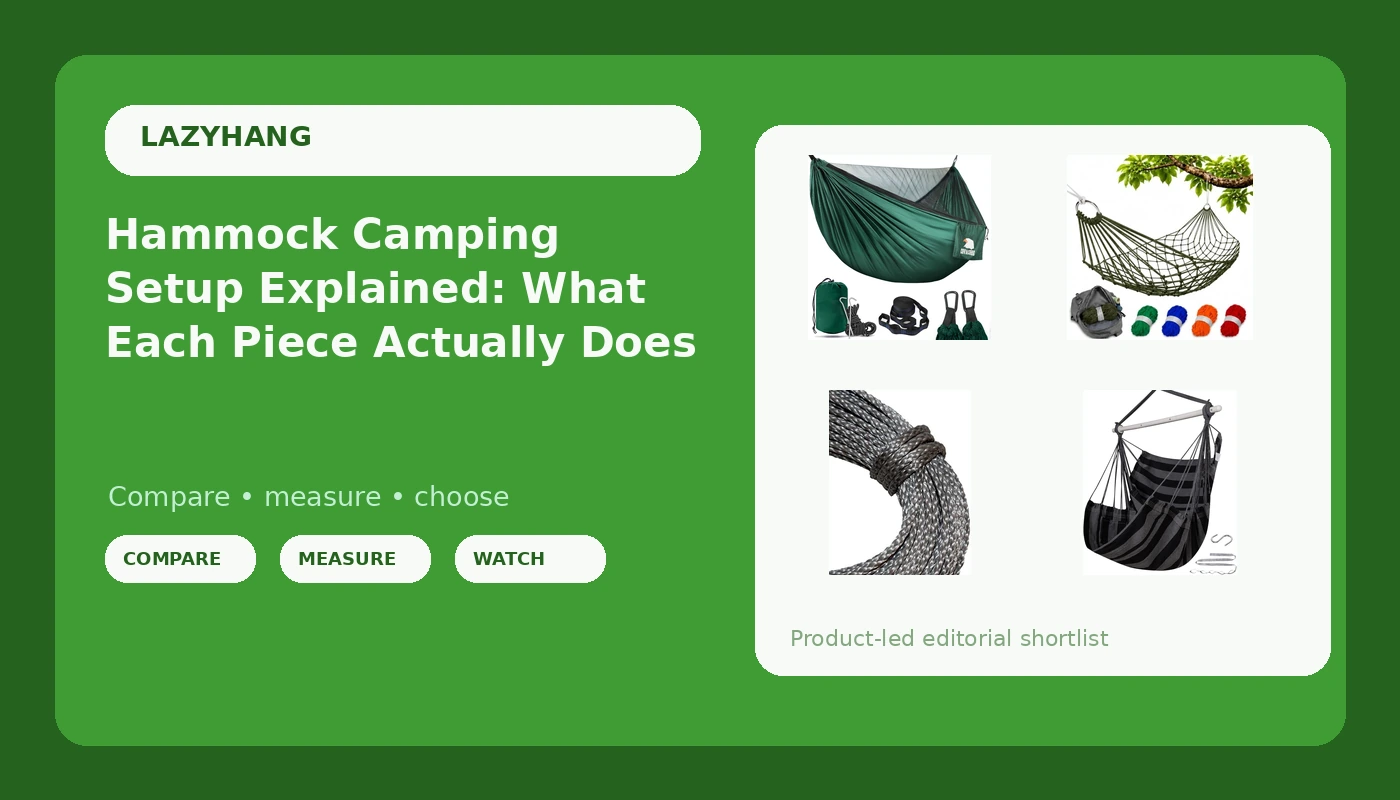
A hammock camping setup is a system, not a single purchase. The fabric holds you, the suspension decides whether you sleep flat or curl like a banana, and the extras decide whether you stay dry and bug-free. Most people buy the hammock first and spend the next season figuring out what was missing. This explainer covers four pieces of hammock gear, a double camping hammock, a mesh net hammock, a length of Dyneema rope, and a hammock chair swing, and explains which problem each one actually solves so you can match the gear to the way you hang.
Related: How to Hang a Hammock Without Damaging Trees →
Quick answer
For overnight camping, a double-width hammock paired with wide tree straps and a separate rain fly covers the core sleep system. A mesh net hammock suits hot, humid afternoons, dry storage, and casual day hangs rather than cold nights. Dyneema rope belongs in the suspension as a structural ridgeline or whoopie sling, never wrapped directly around a tree. A hammock chair swing is furniture for a porch, bedroom, or patio, not a camping shelter. Match each piece to its job and you avoid buying the same thing twice.
Four useful options
| Model | Best fit | What stands out |
|---|---|---|
| Covacure Camping Hammock, 772 lbs Capacity Double Hammock - Dark Green | Overnight camping and two-person day hangs | Double-width body with a stated 772 lb capacity |
| Mesh Hammock, Net Hammock for Outside Camping, 220 lb, Dark Green | Hot-weather lounging and quick day hangs | Open mesh body with a stated 220 lb capacity |
| Samson Amsteel Blue Rope 1/4" Strong Dyneema Fiber | Structural ridgelines and spliced suspension parts | Stated 8600 lb tensile strength in a 12-strand, low-stretch line |
| ADVOKAIR Hammock Chair Swing 500lbs Steel Bar Multi-Size Bedroom&Porch | Porch, patio, and bedroom seating | Steel bar spreader with a stated 500 lb capacity |
The double hammock: Covacure Camping Hammock
A double hammock is a geometry tool more than a capacity statement. The extra width lets one person lie on the diagonal, which is how you get a flat, shoulder-friendly position instead of a curved spine. Two people can share it, but only if both are comfortable being close, and the stated capacity is a manufacturer figure, not a guarantee that two adults plus gear will sleep well. Treat the double body as room to move, and plan on adding your own tree straps and a rain fly, because neither is part of this listing. If your hang angle is wrong, the width will not save you.
The mesh net hammock: Mesh Hammock, Net Hammock for Outside Camping
Net hammocks have a clear job and a clear limit. The open weave breathes, dries fast, and packs small, which makes it a good choice for a hot afternoon, a boat, a screened porch, or a garage wall where you want something that will not hold dampness. The trade-off is everything else: mesh offers no wind blocking, no insulation, and nothing to stop biting insects, so it is not a camping sleep system on its own. The 220 lb stated capacity is also meaningfully lower than the double hammock above, so check the number against the person using it. A mesh hammock is the one you keep for summer lounging, not the one you trust at 3 AM.
The suspension line: Samson Amsteel Blue Rope
This is the piece people get wrong. Rope is not tree protection. A structural ridgeline runs between the two ends of your hammock to lock in a consistent sag, and a whoopie sling replaces a bulky suspension line with something you can adjust in seconds. Both are legitimate uses for a low-stretch, spliceable Dyneema line, and 25 feet is enough to build several of them. What you must not do is wrap this around a trunk. Thin cord concentrates load on a narrow band of bark and can girdle a tree, which is why two-inch wide tree straps stay in the kit regardless of how strong the rope is. Low stretch matters here: a line that creeps under load changes your hang angle overnight, and hang angle is what flat sleeping depends on.
The hammock chair: ADVOKAIR Hammock Chair Swing
A hammock chair keeps the fabric off your shoulders and holds you upright, which is a completely different posture from lying flat, and that is the point. The steel spreader bar keeps the seat open so you can sit down without fighting the fabric. Because it hangs from a single anchor point, it needs a mounting location rated for the load you are putting on it, and the hardware you use to attach it matters as much as the chair. Keep it indoors or on a covered porch, and do not confuse it with a camping hammock. A chair is for canceling an afternoon of yard work, not for sleeping through a rainstorm.
Prices and availability may change. Product images, names, and retailer links are matched to verified listings. No current price, rating, stock status, or measured result is stated here without current evidence.
How the layers of a hammock camping setup fit together
A hammock sleep system stacks in layers, and each layer has a different failure mode. The fabric body is the layer you lie in, and its width and length determine whether you can sleep on the diagonal. The suspension is the layer that connects you to the trees, and it includes both the line at each end and the straps around the trunk. The structural ridgeline sits above your head and fixes the distance between the two ends of the hammock, which sets the sag no matter how far apart the trees are. On top of that come the camping layers: insulation underneath to stop convective heat loss, a tarp overhead for rain, and a bug net when insects are active.
The four products here map onto three of those layers. The Covacure double hammock is a fabric body built for camping. The mesh net hammock is a different kind of fabric body, optimized for airflow rather than sleep. The Amsteel Blue rope is suspension hardware for ridgelines and slings. The ADVOKAIR chair is furniture that happens to hang. Knowing which layer you are shopping for is what stops you from buying a fourth hammock when what you actually needed was a ridgeline.
Hanging geometry: sag, ridgeline, and the 30-degree rule
Sag is the single biggest variable in whether a hammock is comfortable, and it is independent of price. A hammock hung too tight feels unstable and stiff. A hammock hung too loose wraps around your shoulders and curls you up. The widely used starting point is a suspension angle of roughly 30 degrees from horizontal, measured where the line meets the tree, which puts the hammock body low and gives you room to lie diagonally. A structural ridgeline makes that angle repeatable: once the ridgeline is set, the sag stays consistent even when your two trees are further apart than last time.
- Check the span first. Confirm the distance between your hang points fits your straps and the hammock, and that both anchors are sound, living trees or rated structural points.
- Set the suspension angle near 30 degrees rather than pulling it guitar-string tight.
- Add a structural ridgeline if your hammock does not have one, using a low-stretch line and a splice or knot you trust.
- Lie diagonally across the fabric, not along its centerline, so your body can flatten out.
- Re-check tree protection before you get in: two-inch wide straps, never bare rope or thin cord.
Practical guidance before you buy
- Match the stated capacity to the real load, including the person, clothing, and anything in the hammock. A 220 lb rating and a 772 lb rating describe very different use cases.
- Buy straps separately if they are not included. Wide webbing protects bark and holds better than any cord.
- Choose solid fabric for sleeping and mesh for lounging. A net hammock is not a substitute for a camping hammock.
- Keep rope in the suspension layer, not around a trunk. Dyneema is excellent for ridgelines and whoopie slings and wrong for wrapping trees.
- Plan the whole system before the trip: hammock, straps, ridgeline, insulation underneath, and a tarp overhead. A hammock alone is a nap, not a night.
- For a hammock chair, verify the anchor and the mounting hardware before you hang it, and keep it in covered spaces.
Which option should you choose?
Choose the Covacure Camping Hammock when you want a double-width fabric body for camping, backyard naps, or two-person day hangs, and you are prepared to add your own straps and rain fly. Choose the Mesh Hammock, Net Hammock for Outside Camping when you want airflow on a hot day, a fast-drying lounger, or a low-cost hang that lives outdoors and never needs to keep you warm. Choose the Samson Amsteel Blue Rope when you are building a structural ridgeline, a whoopie sling, or a continuous loop and you want a low-stretch, spliceable line. Choose the ADVOKAIR Hammock Chair Swing when you want seating on a porch, patio, or in a bedroom and you have an anchor point rated for the load.
The stated capacities and measurements above come from the product listings, not from independent testing, and they should be treated as manufacturer figures. Check the current listing for the specifications that matter to you, confirm your own anchor points and hardware, and remember that hang angle and strap width affect comfort and tree health more than any single number on a box.
The bottom line
A hammock camping setup works when each piece does one job. The Covacure double hammock gives you a wide fabric body with a high stated capacity for sleeping and lounging. The mesh net hammock handles hot-weather airflow and dries quickly, at a lower stated capacity. The Samson Amsteel Blue rope supplies low-stretch, spliceable suspension for ridgelines and slings, provided it never touches bark. The ADVOKAIR hammock chair turns a single anchor point into seating indoors or on a porch. Buy the layer you are actually missing, hang it near 30 degrees, use wide straps, and the rest of the system gets easier from there.