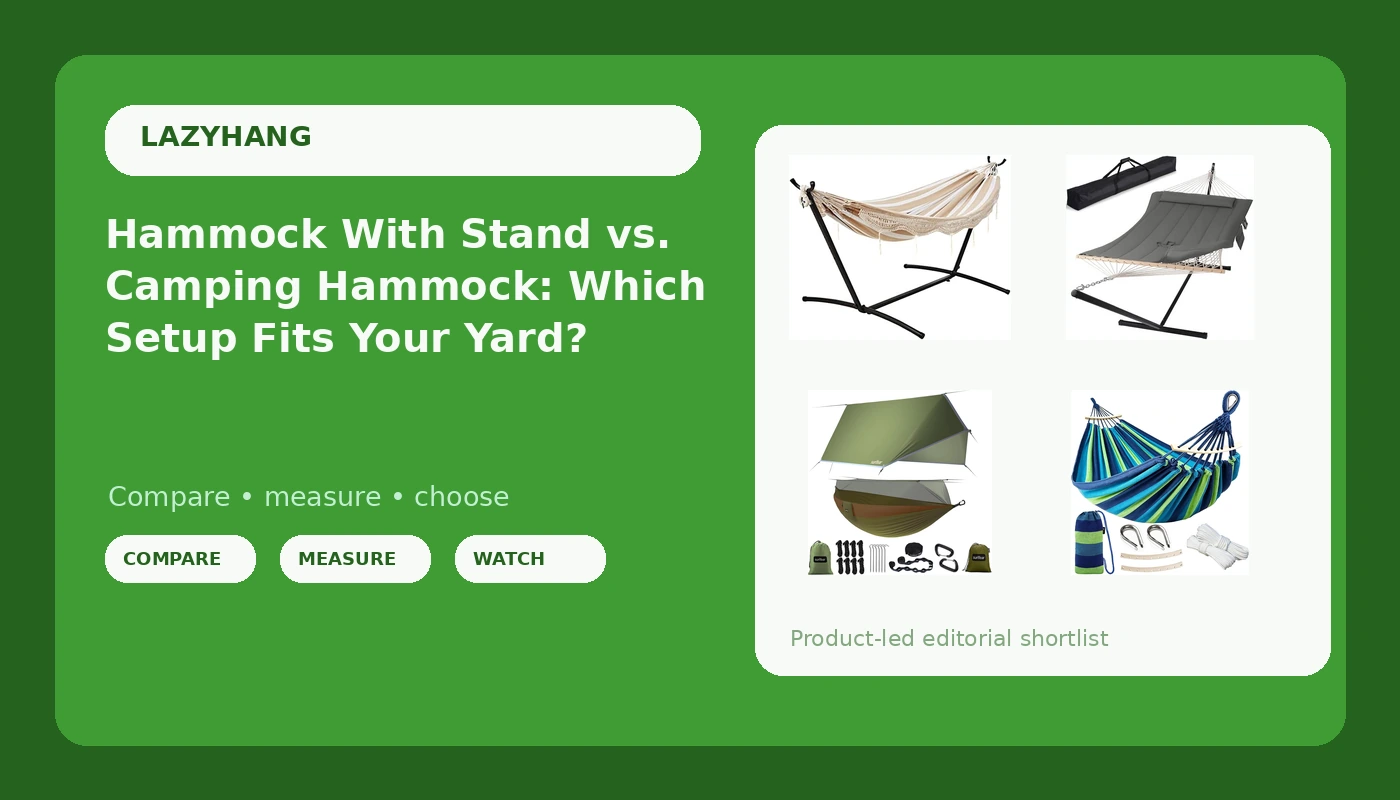
Hammocks split into two families, and the names do not help you tell them apart. A hammock with stand is furniture: fabric, a frame, and a footprint you can drag from the patio to the lawn. A camping hammock is a sleep system: gathered-end fabric, a suspension that wraps wide around a trunk, and often a bug net that closes over your head. Both get sold under the same word, both land in the same search results, and both get returned for the same reason. The buyer picked the wrong family for the place they actually hang. This guide walks through four specific options and the geometry, suspension, and stand questions that decide which one fits your situation.
Related: How to Hang a Hammock Without Damaging Trees →
Quick answer
Decide by where you will actually hang it, not by color or price. If you have no suitable trees, or you want something you can reposition around a yard, choose a hammock with stand. If you plan to sleep overnight away from home, choose a camping hammock with an integrated net and tree straps. The two freestanding options here differ mainly in stand size and how they pack down. The two non-stand options differ in fabric type and whether a net is built in.
Four useful options
| Model | Best fit | What stands out |
|---|---|---|
| 275x155cm Camping Hammock Outdoor | Backyard lounging | Detachable spreader bars hold the bed flat, and the listing rates it to 660 lb |
| Amazon Basics Double Hammock with 9-Foot Space Saving Steel Stand and Carrying Case | One-piece patio setup | Hammock, steel stand, and carrying case ship together in one purchase |
| SUNCREAT Double Outdoor Hammock with Stand, Carrying Bag, Dark Gray | Freestanding double | Double-width bed on an included stand, with a bag for storage |
| Sunyear Camping Hammock | Overnight camping | Integrated net plus two 10 ft straps, in a portable single or double layout |
The backyard lounger: 275x155cm Camping Hammock Outdoor
Spreader bars change the feel of a hammock more than any other single feature. They hold the fabric wide, so you can sit sideways, read, or set a drink down without the sides folding in around you. The trade-off is the shape: a flat bed with bars is comfortable for lounging, but it does not give you the diagonal flat lay that a gathered-end camping hammock is designed for. Cotton is also a fair-weather fabric. It feels good against skin, and it holds moisture if you leave it out through a storm, so plan to bring it in when the weather turns. Note that this one does not include a stand, so you still need two anchor points, and the listing should be checked for the hanging hardware you will need.
The all-in-one: Amazon Basics Double Hammock with 9-Foot Space Saving Steel Stand and Carrying Case
This is the least complicated path if your yard has no trees, or if the trees you have are the wrong distance apart or too small to trust. The stand does the geometry for you, which is the main appeal. It also sets the limits. A stand needs reasonably level ground and a clear span of roughly its own length, so measure before you buy. It is not something you carry on a hike, and it will not pack into a weekend bag. If your goal is a permanent or semi-permanent spot in the yard that anyone in the household can use without learning a suspension system, this is the shape of product to look at.
The freestanding double: SUNCREAT Double Outdoor Hammock with Stand, Carrying Bag, Dark Gray
Two freestanding doubles in one shortlist is not redundant, because the details that separate them are the details that matter for a stand. Frame dimensions, the shape of the feet, how the fabric attaches, and how much assembly is required all vary between listings, and any of them can decide whether the thing fits your patio. Compare the listed stand footprint and the listed capacity side by side rather than assuming they are interchangeable, and check the assembly notes in the current listing before ordering. A darker fabric is a practical choice if the hammock will live outside for months, since pale lace and stripes show pollen, sap, and dust quickly.
The camping system: Sunyear Camping Hammock
This is a different category of product, and it is the one to consider if overnight use is the point. A net is not a luxury in most of the Southeast, where a warm evening without one is an invitation to be eaten alive. Included straps are a good sign, since rope damages bark and rope-based suspensions are the most common failure point in a cheap setup. Two things to check in the listing: the strap width, because wider webbing is gentler on trees, and whether the net entry zips from a position you can reach from inside the hammock. The listing also does not mention a rain fly, so budget for a tarp separately if you plan to sleep out in weather.
Prices and availability may change. Product images, names, and retailer links are matched to verified listings. No current price, rating, stock status, or measured result is stated here without current evidence.
Why hammock geometry decides comfort
Every complaint about hammocks, from "it folds me in half" to "my back hurts in the morning", traces back to geometry rather than fabric quality. A gathered-end hammock hung too tight becomes a taut curve that pushes your shoulders together. Hung too loose, it swallows you into a deep banana shape. The working target is roughly a 30-degree angle between the suspension and the ground, which produces enough sag that you can lie on the diagonal and end up genuinely flat.
A structural ridgeline is the tool that makes that angle repeatable. It is a cord running between the two ends of the hammock, set to a fixed length, that holds the sag constant no matter how far apart the trees are. Without one, every hang is a new experiment. With one, you hang the same way in a tight site and a wide one.
Spreader bars solve the geometry a different way, by forcing the fabric open into a flat rectangle. That is why the bar-based option here reads as a lounger: it is stable, easy to get in and out of, and comfortable for sitting. It is not the same flat lay you get from a diagonal in a gathered-end bed, and it is not designed to be pitched between two trees in the backcountry. Neither approach is wrong. They are answers to different questions.
Fabric matters second, not first. Nylon and polyester blends tend to stretch under a sleeper's weight over a night, which is why ridgelines and correct sag matter so much. Cotton feels softer and breathes well, but it is heavier, slower to dry, and best kept out of sustained rain.
Suspension, stands, and the five questions to answer before you buy
- Measure your hang. For a gathered-end hammock, look for anchor points roughly 13 to 15 feet apart. If you cannot find that, a stand is the honest answer.
- Check the straps, not just the hammock. Wide webbing, ideally around 2 inches, protects bark and holds better than thin cord or rope.
- Decide trees or no trees. Stands need level ground and clearance for the frame. Trees need healthy trunks of a workable diameter and a clear space underneath.
- Match the bed to the job. Single-width is for sleeping. Double-width is for lounging with company, and a "double" that two adults actually share is rarer than the label suggests.
- Plan for weather. A net handles insects and a tarp handles rain. A cotton backyard hammock handles neither, so store it dry.
Practical guidance before you order
- Measure the stand footprint against your patio or lawn space, including the room the legs need to sit flat.
- Verify the listed capacity against the heaviest person who will use it, and treat it as a ceiling rather than a target.
- Confirm what is actually in the box. A hammock without a stand needs a suspension, and a hammock with straps may still need a tarp.
- Read the assembly notes in the current listing. Some stands go together with pins, others with bolts and tools you may not own.
- Set the hammock up at home first. A dry, warm night in the yard is the cheapest way to find out whether the sag is right before you rely on it somewhere with no easy exit.
Which option should you choose?
Choose the 275x155cm Camping Hammock Outdoor when you have two solid anchor points and want a flat, sit-friendly bed for reading and afternoon naps in the garden. Choose the Amazon Basics Double Hammock with 9-Foot Space Saving Steel Stand and Carrying Case when you want one purchase that covers the hammock, the frame, and storage, and you have level ground to put it on. Choose the SUNCREAT Double Outdoor Hammock with Stand, Carrying Bag, Dark Gray when you want the same freestanding convenience in a darker fabric, and its listed frame dimensions suit your space better. Choose the Sunyear Camping Hammock when the plan involves sleeping outside, where the integrated net and included straps matter more than any backyard comfort feature.
Every specification above comes from the product listings, and listing details change. Confirm dimensions, capacity, and included accessories on the current page before you commit, especially if you are buying for a specific space or a specific person's weight.
The bottom line
The hammock question is really a location question. If your hanging spot is a yard with no usable trees, a stand-based set removes the entire problem and gives you something the whole household can use without learning a suspension system. If your hanging spot moves, and especially if it involves sleeping outdoors, you want a camping hammock with a net and wide straps, and you should budget for a tarp on top of it. The spreader-bar lounger sits between them: flat, stable, and pleasant for daytime, provided you keep cotton out of the rain. Pick the family that matches where you hang, then compare the listed specs inside that family. That order of operations saves more returns than any single feature on this page.