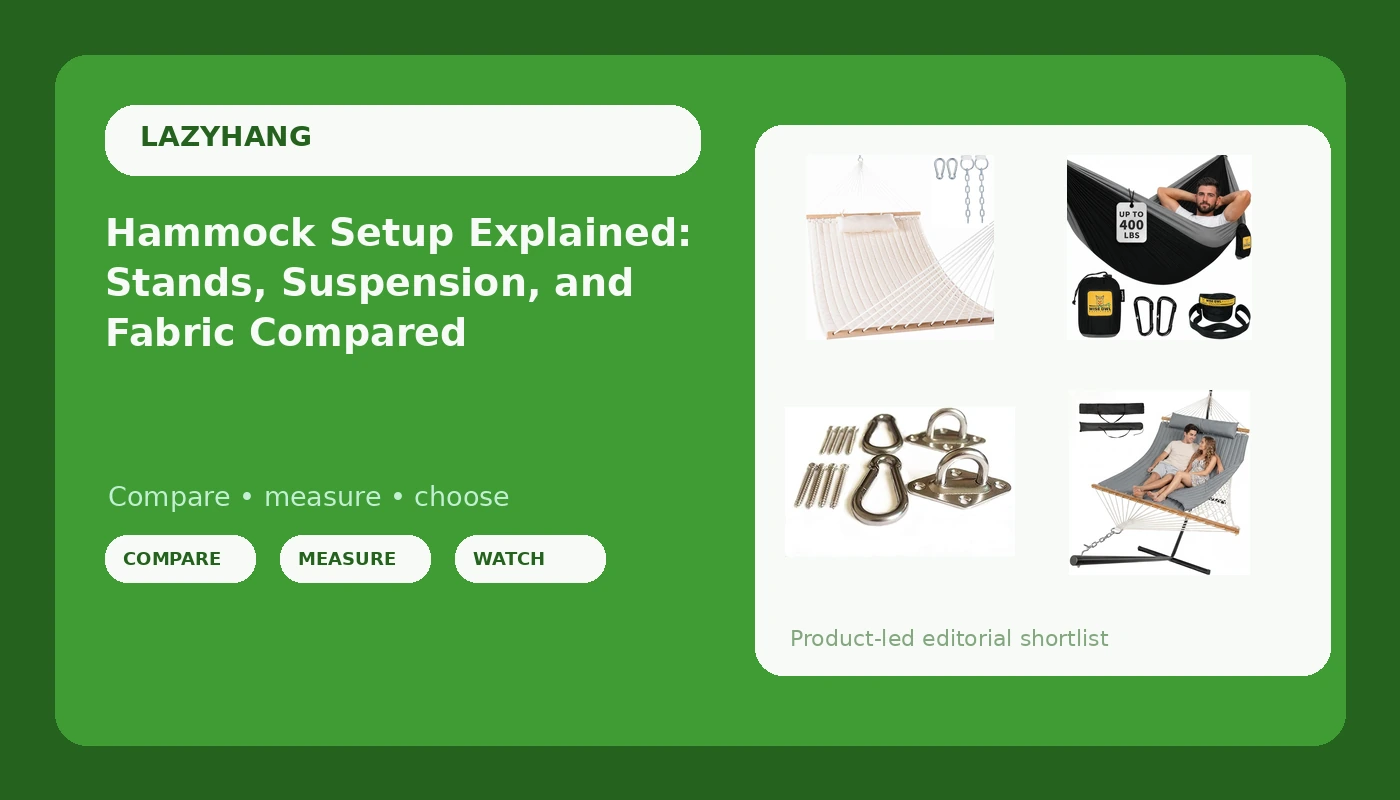
Most people who go shopping for a hammock are not really buying one thing. They are buying three decisions at once: what the fabric feels like under your back, what holds the hammock in the air, and where that support comes from. Get those three out of alignment and the nicest fabric in the world still leaves you curled like a banana at 3 AM. Get them aligned and a modest setup sleeps better than an expensive one.
That is the whole reason a hammock stand and hanging kit question gets complicated so fast. Four listings that all say "hammock" can be four completely different products. One is a complete stand system with the hammock included. One is a quilted fabric hammock built for a stand you already own. One is a lightweight nylon hammock meant to disappear into a backpack. One is a small bag of hooks and carabiners that exists so the other three can hang safely.
This explainer walks through what each of those actually is, who it fits, and what the trade-offs look like. No rankings, no invented lab numbers, just the geometry and the hardware that decide whether a hammock works.
Related: How to Hang a Hammock Without Damaging Trees →
Quick answer
If you have no trees and want one box to solve the whole problem, the complete stand system is the straightforward pick. If a stand is already sitting in your yard and you want a softer, flatter surface than bare rope, the quilted fabric hammock is the one that fits a 13 to 15 ft stand. If the hammock has to travel, the portable parachute nylon single is the light option. And if you already own a hammock but the mounting hardware is questionable, the heavy duty hanging kit is the piece that makes the rest of the system trustworthy. Fabric matters, but suspension and hang angle decide whether you actually sleep.
Four useful options
| Model | Best fit | What stands out |
|---|---|---|
| ANAGOO Hammock with Stand, Cotton Rope Hammock with Polyester, Gray | No trees, one-box setup | Ships as a matched pair of stand and hammock body |
| Lazy Daze Double Quilted Hammock with Pillow for Outside, Fit 13-15Ft Stand | A stand you already own | Quilted fabric surface with an included pillow |
| Wise Owl Outfitters Hammock for Camping Single Hammocks Gear for The Outdoors Backpacking Survival or Travel - Portable Lightweight Parachute Nylon SO Black & Grey | Packing and travel | Parachute nylon in a single size |
| MHMYDZ 1000 lb Capacity Heavy Duty Hammock Hanging kit Ultra Durable Hooks Carabiners for Hammock Stand Hammocks Swing Chair,Multiple Indoor Outdoor Suspension Ceiling Hooks | Replacing or adding hardware | Hooks and carabiners for stands, beams, and swing chairs |
Complete setup: ANAGOO Hammock with Stand, Cotton Rope Hammock with Polyester, Gray
The appeal here is subtraction. You are not measuring trees, not sourcing hardware, not guessing whether a hammock body will fit a frame you bought separately. The stand and the hammock arrive as a set, which means the geometry problem has already been solved by someone else.
The trade-off is portability. A stand is a stand. It lives in one place, it takes up floor or patio space, and it does not fold into a backpack. That makes this the right shape of product for a yard, a deck, or a sunroom, and the wrong shape for a thru-hike. Rope bodies also behave differently from nylon: they tend to feel more like a woven bed and less like a fabric cocoon, which some people love and others never adjust to. If your hammock time happens at home, this is the version of the purchase that removes the most friction.
Fabric hammock: Lazy Daze Double Quilted Hammock with Pillow for Outside, Fit 13-15Ft Stand
This is the piece most shoppers get wrong, because the sizing is not optional. The listing states it fits a 13 to 15 ft stand. If your frame is shorter or longer than that window, this hammock is the wrong body for it, no matter how good the quilting feels. Measure the stand you own before anything else.
What you get in exchange for that measurement is a spread-out, quilted surface with a pillow. Quilted fabric distributes pressure differently than rope, which tends to be the difference between "this is pleasant for twenty minutes" and "I could read here all afternoon." It is a comfort-first product for a fixed location. It is also the one product in this group that assumes you already solved the stand problem, so budget accordingly if you have not.
Portable option: Wise Owl Outfitters Hammock for Camping Single Hammocks Gear for The Outdoors Backpacking Survival or Travel - Portable Lightweight Parachute Nylon SO Black & Grey
Parachute nylon is the material that made hammock camping mainstream, and it earns that reputation for one reason: it packs small and weighs little. A single-size nylon hammock rolls into a shape that disappears into a pack, which is exactly what the stand-based products in this guide cannot do.
The honest framing for this one is that it is a hammock body, not a complete sleep system. Camping hammocks need suspension, and they need a way to manage sag so you lie flat instead of curling. Nylon also has a reputation for stretching under a sleeper's weight, which is a fabric property, not a flaw in this particular model. For a backyard nap, a park afternoon, or a travel hammock that lives in a daypack, the nylon single is the obvious shape. For cold, wet, overnight camping, treat it as one component of a system you are still assembling, because a bug net and a tarp are separate purchases.
Hardware kit: MHMYDZ 1000 lb Capacity Heavy Duty Hammock Hanging kit Ultra Durable Hooks Carabiners for Hammock Stand Hammocks Swing Chair,Multiple Indoor Outdoor Suspension Ceiling Hooks
This is the least exciting product in the group and arguably the most consequential. Every hammock failure story ends in the same place: the point where the hammock met whatever was holding it. Hooks, carabiners, and mounting plates are the load path, and the load path is where you should spend attention before you spend it on fabric color.
The capacity figure in the name comes from the listing, so treat it as the manufacturer's stated rating rather than a measurement. What matters practically is that this kit exists to solve stand mounting, ceiling and beam mounting, and swing chair suspension with hardware that is actually designed for a hanging load. If you own a hammock with included rope, this is the upgrade that replaces it. Rope is not a suspension system, and it is not kind to tree bark either.
Prices and availability may change. Product images, names, and retailer links are matched to verified listings. No current price, rating, stock status, or measured result is stated here without current evidence.
Why hang angle matters more than fabric
A hammock is a geometry problem wearing a fabric costume. The angle at which the suspension meets the hammock, measured from horizontal, determines the shape your body ends up in. Too shallow, closer to a straight line, and the hammock turns into a narrow trough that squeezes your shoulders. Too steep and you sink into a deep U that folds you at the hips.
The commonly cited sweet spot is around 30 degrees, which sounds fussy until you feel the difference. At a good angle the hammock body relaxes into a broad diagonal, and you can lie across it rather than along it. That diagonal is what makes flat sleeping possible. Lying straight down the centerline of any gathered-end hammock produces the banana curve everyone complains about.
This is also where a structural ridgeline earns its reputation. A ridgeline is a cord running from one end of the hammock to the other, and it fixes the amount of sag regardless of how far apart your anchor points happen to be. Without one, every hang is a new experiment, because the distance between trees or posts changes the angle. With one, the hammock hangs the same way every time, and the only variable left is how high you tie off.
That matters for the stand-based products here too. A stand sets the distance for you, which is why matching a hammock body to the stand's length range is the first thing to check. It is not a suggestion. It is the geometry.
Straps, hardware, and the load path
Suspension is the part of a hammock system people skip, and it is the part that touches trees, beams, and your safety. Two things matter: width and material.
Tree straps should be wide, and two inches is the number that gets repeated for good reason. Wide webbing spreads force across a band of bark instead of cutting into it. Thin cord, rope, or bare carabiners cinched against a trunk will girdle a tree over time, which is why parks and forests increasingly require wide straps and ban rope outright. If a hammock ships with rope in the box, that rope is a placeholder, not a suspension system.
The second consideration is the hardware itself. Carabiners, hooks, and mounting plates carry the entire load, and they should be rated for it and inspected before each hang. Indoors, mounting to a ceiling or beam means finding structure, not drywall. Outdoors, it means choosing anchors that will not move and straps that will not slip.
- Decide where the hammock will actually hang: stand, trees, or ceiling and beam mounting.
- Measure the space. For a stand, confirm the length range the hammock body is built for.
- Check the suspension. Wide straps for trees, rated hardware for everything else.
- Set the hang angle near 30 degrees, or use a structural ridgeline so the sag is fixed.
- Lie in it diagonally, not down the centerline, and adjust height before you commit to a nap.
Practical guidance before you buy
- Measure your stand before you shop for a hammock body. A 13 to 15 ft fit range is a hard requirement, not a preference.
- Treat rope in the box as packaging. Replace it with wide straps or rated hardware before the first real hang.
- Match the product to the location. Stand systems stay put, nylon singles travel, quilted bodies stay home.
- Expect to buy in stages if you are camping. A nylon hammock body is the start of a sleep system, not the whole of one.
- Check the load path every season. Hooks, carabiners, and mounting points wear, and they are cheap to replace compared to a fall.
- Ignore color and branding until the geometry checks out. Fabric is the last decision, not the first.
Which option should you choose?
Choose the ANAGOO Hammock with Stand,Cotton Rope Hammock with Polyester, Gray when you have no trees, no beams, and no interest in sourcing hardware separately, and you want the stand and the hammock to arrive already matched. Choose the Lazy Daze Double Quilted Hammock with Pillow for Outside, Fit 13-15Ft Stand when a stand is already in your yard, it measures within that 13 to 15 ft range, and you want a quilted surface with a pillow instead of rope or thin nylon. Choose the Wise Owl Outfitters Hammock for Camping Single Hammocks Gear for The Outdoors Backpacking Survival or Travel - Portable Lightweight Parachute Nylon SO Black & Grey when the hammock needs to pack down and travel, and you understand that suspension and weather protection are separate purchases. Choose the MHMYDZ 1000 lb Capacity Heavy Duty Hammock Hanging kit Ultra Durable Hooks Carabiners for Hammock Stand Hammocks Swing Chair,Multiple Indoor Outdoor Suspension Ceiling Hooks when you already own a hammock and what you actually need is the hardware and mounting points that make hanging it a reasonable idea.
One caveat worth stating plainly: nothing here is a substitute for checking your own setup. Stand dimensions vary, mounting surfaces vary, and the capacity figure on the hardware kit is the listing's stated rating, not an independently verified result. Confirm fit and anchoring for your specific space before you hang anything, and never mount a hammock to a surface you have not confirmed can carry the load.
The bottom line
The four products in this guide are not four versions of the same decision. They are four different jobs. A complete stand system removes the need for trees and hardware. A quilted fabric body upgrades a stand you already own, provided the length matches. A nylon single is the travel option and the beginning of a camping system rather than the end of one. A hanging kit is the invisible part that decides whether any of the others hold.
Buy the job you actually have. Then spend your remaining attention on the two things that genuinely change how a hammock sleeps: a hang angle near 30 degrees, and suspension that is wide, rated, and inspected. Fabric is what you notice for the first ten minutes. Geometry and hardware are what you notice at 3 AM.