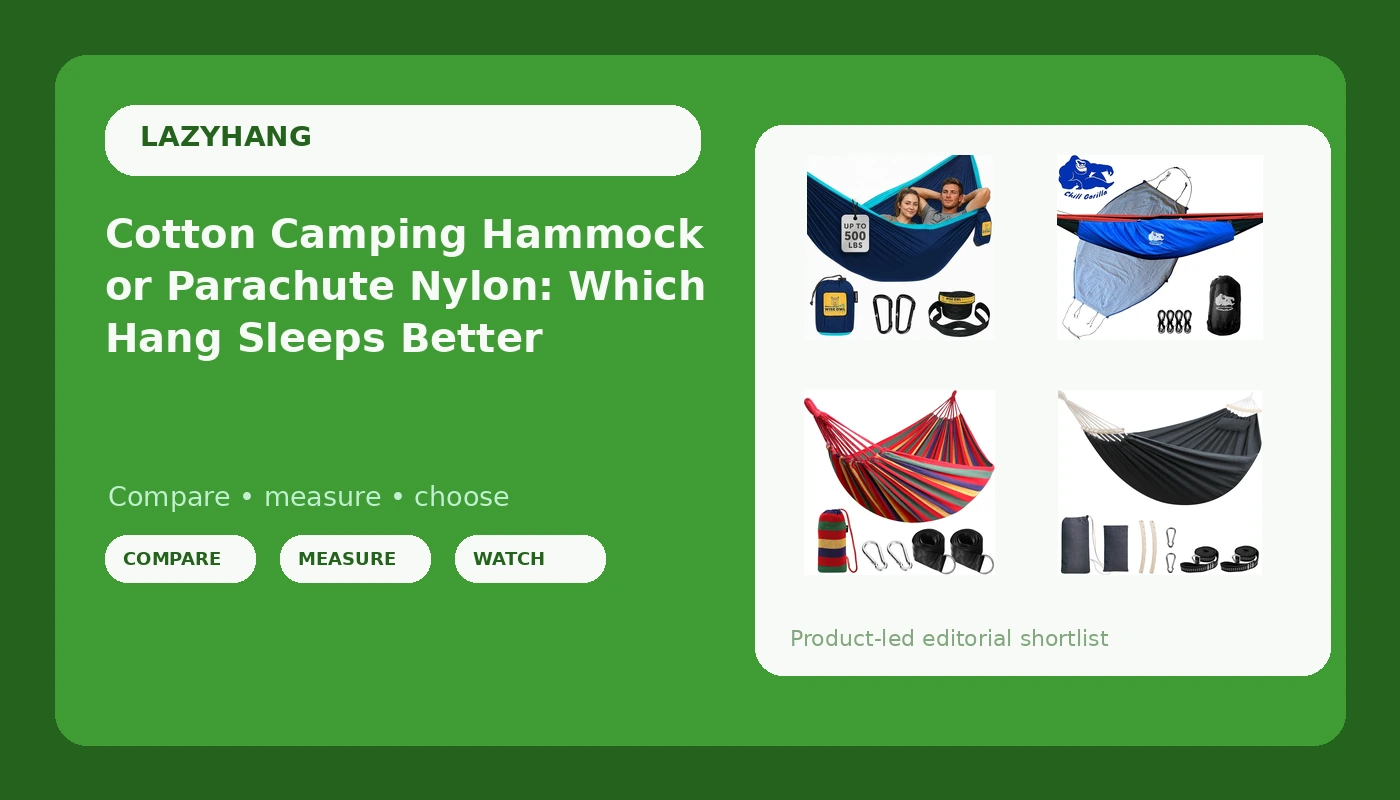
Two hammocks can sit on the same shelf, share a similar color story, and both list a 660 pound capacity, and still be completely different places to sleep. That is the gap this guide is written to close. If you are shopping for a cotton camping hammock, or weighing one against the parachute nylon double that half the campground seems to own, the real question is not which fabric sounds better in a product title. It is where you hang, how far you carry the thing, how cold the night runs, and whether the suspension that ships in the box is safe for the tree you tie it to. Below are four current options, what each one is actually for, and the setup rules that decide whether any hammock is comfortable at 3 AM.
Related: How to Hang a Hammock at 30 Degrees Without Overthinking It →
Quick answer
There is no single winner here, because these four options are built for different trips. For a backyard, porch, or drive-in campsite where weight does not matter, the two cotton hammocks are the natural starting points, and the ANYOO is the one that ships with tree straps in the box. If you want a wider cotton bed and a design the listing describes as reducing side-tipping, compare the Chihee. If the hammock has to fit inside a pack, the Wise Owl parachute nylon double is the lighter fabric choice. And if you plan to sleep on cool nights, budget for the Chill Gorilla underquilt, because insulation under your back matters more than any fabric upgrade.
Four useful options
| Model | Best fit | What stands out |
|---|---|---|
| ANYOO Cotton Camping Hammock Portable with Tree Straps Holds 660lbs | Backyard and car camping hangs | Cotton body, listed 660 pound capacity, tree straps included |
| Chihee Cotton Hammock 8.9x4.9ft Holds Up to 660lbs Prevents Side-Tipping | Sleepers who want a wider cotton lay | Listed 8.9 x 4.9 ft cotton body with a side-tipping reduction design |
| Wise Owl Outfitters Hammock for Camping Double Hammocks Gear for The Outdoors Backpacking Survival or Travel - Portable Lightweight Parachute Nylon DO Navy & Lt Blue | Packable travel and backpacking | Double size in lightweight parachute nylon |
| Chill Gorilla Hammock Underquilt. Lightweight Camping Quilt. Hammock Camping Accessories. Blue | Cold-weather hanging | Underquilt insulation that suspends beneath the hammock |
The entry point: ANYOO Cotton Camping Hammock Portable with Tree Straps Holds 660lbs
The reason included straps matter is not convenience, it is trees. Rope and thin cord bite into bark and can girdle a trunk over a season, which is why the two inch flat strap is the standard. This hammock ships with straps rather than rope, but check the width yourself when it arrives, and swap in wider webbing if what you got looks narrow. The trade-off with cotton is weight and drying time. A cotton body is heavier in a pack and slower to dry after a wet night or a humid one, so treat this as a campsite hammock rather than a backpacking one.
The wide cotton lay: Chihee Cotton Hammock 8.9x4.9ft Holds Up to 660lbs Prevents Side-Tipping
Side-tipping is what happens when a hammock is too narrow for your shoulders or hung too tight, and the whole thing rolls you toward the center. A wider cut gives you more room to lie corner to corner, and that diagonal is where flat sleeping comes from. The same cotton caveats apply here: this is a lounging and car camping fabric, not a lightweight one. Pair it with a structural ridgeline if you want the sag to stay consistent, and remember that a wider hammock also wants a slightly longer tree span to hang at the same angle.
The packable nylon double: Wise Owl Outfitters Hammock for Camping Double Hammocks Gear for The Outdoors Backpacking Survival or Travel - Portable Lightweight Parachute Nylon DO Navy & Lt Blue
Two things to know about the double label. First, double mostly means room to lie diagonally, not a comfortable bed for two adults who want their own space. Second, nylon has more give than cotton, so the hang you set at dusk can feel different by midnight. Set the hammock slightly higher than feels right and expect a little settling. This is also the option here that needs the most supporting gear if you take it camping: a structural ridgeline to lock the sag, a tarp for rain, and a bug net if you are anywhere with mosquitoes.
Prices and availability may change. Product images, names, and retailer links are matched to verified listings. No current price, rating, stock status, or measured result is stated here without current evidence.
The warmth layer: Chill Gorilla Hammock Underquilt. Lightweight Camping Quilt. Hammock Camping Accessories. Blue
Here is the physics that sells this category. When you lie in a sleeping bag inside a hammock, your body weight compresses the insulation underneath you, and compressed insulation stops trapping air. That is why a bag rated for freezing can leave your back cold in a hammock at 55 degrees. An underquilt hangs below the hammock without being crushed, so the loft stays intact. Fit matters: underquilts are usually suspended from the hammock ends with shock cord and adjusted for length and draft, and a quilt that is too short for your hammock leaves cold shoulders. Check the fit against your hammock length before a trip, not at camp.
Fabric decides how you sleep, not how the hammock photographs
Cotton and parachute nylon behave differently in ways that matter more than color. Cotton weaves are typically heavier and bulkier, they breathe well in shade, and they feel cool against skin on a warm afternoon. They also absorb moisture and dry slowly, and cotton has enough give that the sag can creep over the course of a night. That makes cotton a great choice for a yard, a deck, a lake house, or a campsite you drive into, and a poor choice for a pack you carry for miles.
Parachute nylon is a lightweight woven nylon, and it is the fabric that made hammock camping possible for backpackers. It packs small, sheds a light drizzle better than cotton, dries quickly, and has a soft stretch under load that many people find more comfortable than a stiff fabric. The cost is that stretch: nylon geometry changes as you settle, so a ridgeline becomes more useful, not less.
Neither fabric is the correct answer on its own. The trip decides. If the hammock lives between two trees in your yard and never sees a trail, cotton gives you a nicer afternoon. If the hammock has to disappear into a pack and survive weather, nylon is the practical choice.
Geometry and warmth: what a spec sheet will not tell you
Two hammocks with identical fabric and identical length can sleep completely differently, because hang angle does most of the work. A hang that is too tight turns the hammock into a curved tube. A hang that is too loose drops you into a deep pocket and puts your shoulders in a bind. The target most experienced hangers aim for is roughly a 30 degree angle from the suspension to the horizon, which is easiest to judge by holding a hand at the hang point and looking at the line.
- Find two trees roughly 13 to 15 feet apart and about as thick as your forearm, with no dead limbs overhead.
- Wrap two inch straps at a comfortable reach height, well above head level on both trunks.
- Set the suspension so the hammock bottom sits near knee height when empty, then sit in it and check the angle.
- Lie on the diagonal, from one corner to the opposite corner, and confirm your shoulders are not pinched.
- Add a structural ridgeline or an underquilt only after the basic hang feels flat, since both change how the hammock sits.
The setup checklist before you trust a hang
- Check strap width yourself. Two inches of flat webbing protects bark; rope and thin cord do not.
- Never hang over dead limbs, and never higher than you are willing to fall.
- Practice the hang in daylight, at home, before you rely on it in the dark.
- Bring a tarp for rain and a bug net for mosquitoes if you are sleeping outside the yard.
- Test your underquilt fit at home, since a quilt that leaves a gap at the shoulders will not fix itself at camp.
Which option should you choose?
Choose the ANYOO Cotton Camping Hammock Portable with Tree Straps Holds 660lbs when you want a cotton hammock for the yard or a drive-in campsite and you would rather not buy suspension separately. Choose the Chihee Cotton Hammock 8.9x4.9ft Holds Up to 660lbs Prevents Side-Tipping when a wider cotton bed and the listing's side-tipping reduction design are the features you care about. Choose the Wise Owl Outfitters Hammock for Camping Double Hammocks Gear for The Outdoors Backpacking Survival or Travel - Portable Lightweight Parachute Nylon DO Navy & Lt Blue when the hammock needs to pack small and travel. Choose the Chill Gorilla Hammock Underquilt. Lightweight Camping Quilt. Hammock Camping Accessories. Blue when your nights run cool and you want insulation that stays lofted beneath you.
A caveat worth repeating: the details above come from the product listings, not from a controlled test of these specific units. Listed capacities, dimensions, and design descriptions are manufacturer claims, and no measured result, rating, or current price is asserted here.
The bottom line
The cotton versus nylon question is really a question about where you hang. Cotton gives you a heavier, breathable, slower-drying hammock that belongs in a yard or a base camp. Parachute nylon gives you a packable, fast-drying hammock that belongs on a trail. Whichever you pick, spend your attention on the parts the listing photo will not show you: strap width for the trees, a hang angle near 30 degrees for your back, and insulation under the hammock for the hours after midnight. Get those three right and almost any of these four will do its job. Get them wrong and none of them will.