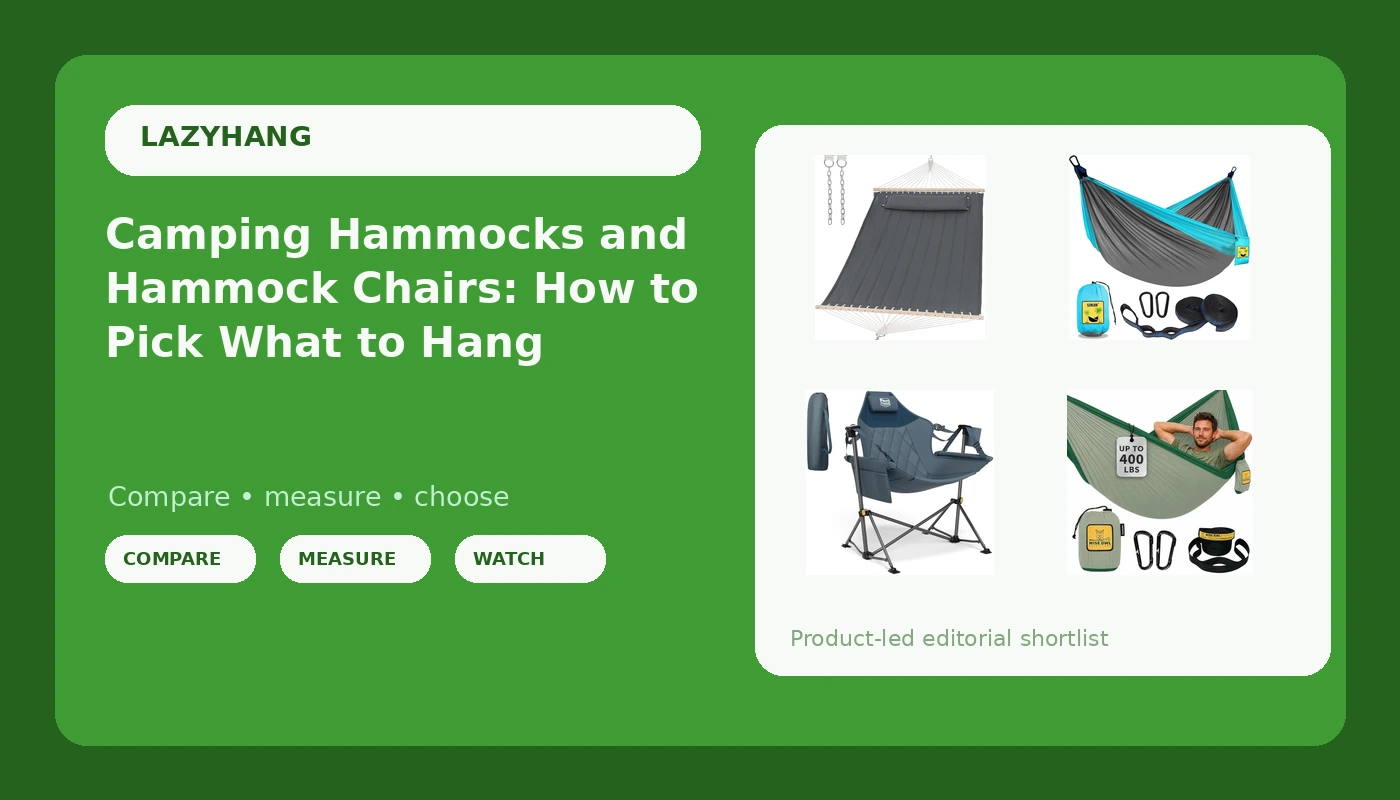
Most people shopping for a hammock are actually shopping for one of two different things, and the listings rarely say which. A camping hammock with tree straps is a sleep system: it depends on hang angle, wide straps that protect bark, and a plan for rain. A backyard hammock is furniture: it needs to be comfortable for an hour and forgiving about how it gets hung. The four options below split along that line, and choosing the wrong side is the most common reason a hammock ends up folded in a closet.
Related: Hammock Straps Explained: Why Width Beats Rope →
Quick answer
A hammock sleeps well when it hangs with roughly 30 degrees of sag on wide, tree-safe straps, and it relaxes well when it is simply a comfortable place to land. For sleeping outdoors, look for a portable hammock that ships with tree straps, such as the Wise Owl Outfitters option. For a two person hang on a porch, patio, or in a living room, the SUNCREAT heavy duty model is positioned for exactly that. The SZHLUX double is the low-commitment way to start, and the TIMBER RIDGE chair is for sitting and swinging rather than lying flat.
Four useful options
| Model | Best fit | What stands out |
|---|---|---|
| SUNCREAT Heavy Duty 2 Person Hammock for Indoor, Outdoor, Gray | Porch, patio, and indoor hangs | Listed as a two person hammock for indoor and outdoor use |
| SZHLUX Camping Hammock Double & Single Portable Hammocks | First hammock, beach days, casual camping | Two tree straps and an attached carry bag come with it |
| TIMBER RIDGE Hammock Camping Chair, Portable Oversized Swinging Camp Chairs | Sitting and swinging at camp | A chair rather than a bed, oversized and portable |
| Wise Owl Outfitters Camping Hammock | Sleeping, travel, and backpacking | Listed capacity up to 500 lbs with tree straps included |
The two person hang: SUNCREAT Heavy Duty 2 Person Hammock for Indoor, Outdoor, Gray
This is the category people picture when they hear the word hammock: something wide enough for two, hung between two points and left there for the season. The trade-off is portability. A hammock positioned for indoor and outdoor use is generally built around comfort and capacity rather than packed size, so it is not the item you stuff into a daypack. If your plan is a porch, a deck, a patio, or a corner of a den, that trade is a good one. If your plan involves a trailhead, read the next two entries first. One more note on two person hammocks: the sizing is real, but two adults sharing one is a social activity more than a sleep strategy. Buy the double for the company, not for the sleeping arrangement.
The low-commitment entry point: SZHLUX Camping Hammock Double & Single Portable Hammocks with 2 Tree Straps and Attached Carry Bag
The single most useful thing about this listing is what comes in the box. Rope is the classic throw-in on cheap hammocks, and rope is what damages bark and slips under load. Tree straps are the right answer, and this one includes them along with a carry bag, which means you can hang it the day it arrives without buying a suspension separately. The trade-off to understand is that included straps are a starting point, not a guarantee. Strap width is the number that protects the tree, so check the width stated in the listing before you wrap anything around a trunk you care about. Treat this as the hammock for a park afternoon, a beach day, or a first overnight in the yard, and it will do its job.
The sit and swing option: TIMBER RIDGE Hammock Camping Chair, Portable Oversized Swinging Camp Chairs
A hammock chair solves a different problem than a hammock does. Sitting and swinging is a genuinely pleasant way to spend an hour at camp, and a chair is easier to place than a bed: it hangs from a single point, so it works where you do not have a clean span between two trunks. What it will not do is replace a sleeping hammock, because you cannot lie flat in a chair and flat is the whole point of sleeping in a hammock. The honest framing is that this is a comfort purchase, not a sleep system. If you already own a hammock for sleeping, this is the thing you add so the campsite has somewhere to sit. If you do not own a hammock yet and your goal is overnight trips, start elsewhere in this list.
The sleep system: Wise Owl Outfitters Camping Hammock
Of the four, this is the one described with the language of backpacking and travel, and that tells you what it is for. The listed capacity is a rating published by the seller, not a measured result, so treat it as the seller's claim and read the current listing for details. The included tree straps matter for the same reason they matter on the SZHLUX: you can hang it without a separate purchase. What this hammock does not include is a bug net or a rain fly, and those are the two things that separate a comfortable night from a long one. Budget for them if you plan to sleep outside between spring and fall. On sizing, single is the sleeping configuration for one person. Double is for two people who like each other, or for one person who wants room to spread out.
Prices and availability may change. Product images, names, and retailer links are matched to verified listings. No current price, rating, stock status, or measured result is stated here without current evidence.
Why sag matters more than fabric
Hang a hammock too tight and you get a flat, unstable surface that dumps you sideways the moment you shift. Hang it too loose and you get the banana curve, a shape that folds your body at the middle and makes your lower back ache by midnight. The middle ground is roughly 30 degrees of sag, measured as the angle of the suspension where it meets the tree. At that angle the hammock settles into a shallow curve, and when you lie diagonally across it, your body ends up close to flat. That diagonal lie is the trick that makes hammock sleeping work at all.
Fabric quality cannot fix bad geometry. A well-made hammock hung at the wrong angle sleeps worse than a plain one hung correctly, which is why experienced hangers spend their first setup adjusting straps rather than shopping for upgrades. A structural ridgeline, which is simply a cord running from one end of the hammock to the other, sets the sag for you and takes the guesswork out of repeat setups. Many hammocks ship without one, and adding a ridgeline is one of the cheapest improvements you can make.
The second variable is stretch. Fabric that relaxes overnight drops you closer to the ground by morning, and the effect compounds if the hammock was hung low to begin with. This is why the overnight test matters: an afternoon nap does not reveal stretch, but eight hours does.
Straps, trees, and how to set a hang
Suspension is where safety and tree health both live. Wide, flat webbing distributes load across bark; thin cord and rope cut into the cambium layer and can girdle a tree over years of repeated use. Two-inch webbing is the common standard in the camping world for a reason. Whatever the box includes, check the stated width in the listing before you trust it against a tree.
- Pick your trees. Look for two sound trunks roughly 12 to 15 feet apart, with no dead limbs overhead and no visible damage at the base.
- Wrap the straps at a comfortable height, well above head level for the strap itself, and keep the webbing flat against the bark rather than twisted.
- Aim for about 30 degrees of sag. If the suspension looks like a tight clothesline, loosen it. If the hammock sags into a deep U, tighten it.
- Sit before you lie. Lower yourself in and test the stability, then lie diagonally and check that your hips and shoulders are level.
- Check the hang again in the morning. Stretch and settling are normal, and a hammock that was right at bedtime may be low by dawn.
Practical guidance before you buy
- Confirm strap width in the listing. Included straps are useful, but width is the detail that protects trees.
- Decide whether you are buying furniture or a sleep system. The two categories have different priorities and rarely overlap.
- Plan for the overnight accessories. A bug net and a tarp are not extras if you intend to sleep outside.
- Choose single sizing if you are sleeping alone. Double sizing is a social feature, not a comfort upgrade for one sleeper.
- Check the hanging points at your site. A chair works from a single anchor; a bed needs a proper span.
- Hang only where it is allowed. Many parks restrict hammock use, and straps do not make a hammock welcome everywhere.
Which option should you choose?
Choose the SUNCREAT Heavy Duty 2 Person Hammock for Indoor, Outdoor, Gray when you want a two person hammock that stays up on a porch, deck, or in a living room and you are not planning to carry it anywhere. Choose the SZHLUX Camping Hammock Double & Single Portable Hammocks with 2 Tree Straps and Attached Carry Bag when you want a low-commitment first hammock that arrives with straps and a stuff bag, and you are mostly hanging in the yard, at the beach, or on easy camping trips. Choose the TIMBER RIDGE Hammock Camping Chair, Portable Oversized Swinging Camp Chairs when what you actually want is somewhere to sit and swing at camp rather than somewhere to sleep. Choose the Wise Owl Outfitters Camping Hammock when your goal is sleeping outdoors and you want a portable hammock that ships with tree straps in a single or double configuration.
One caveat applies to all four: the details that matter most, strap width, fabric, and included hardware, are listed on the product page and can change between production runs. Read the current listing before you commit, and remember that a hammock is only half a sleep system until you add the tarp and bug net.
The bottom line
The right hammock depends on whether you are furnishing a porch or planning a night outside. For a fixed hang with room for two, the SUNCREAT is positioned for indoor and outdoor use. For a cheap first hang with straps and a bag in the box, the SZHLUX covers it. For sitting and swinging, the TIMBER RIDGE is the chair-shaped answer. For sleeping, travel, and backpacking, the Wise Owl Outfitters hammock is the one built around that job, with a listed capacity up to 500 lbs and tree straps included. Whichever you pick, learn the 30-degree hang first. Geometry is free, and it decides how the night goes.