I have slept in more hammocks than beds this year, which is a strange thing to write from a house in Asheville with a perfectly good mattress in the next room. Every summer I run a hammock camp where I hang 20-plus hammocks for a weekend, measure sag, watch fabric relax overnight, and grade each one on the only metric I trust: did I sleep through the night, or did I wake up at 3 AM rearranging myself. This comparison covers the four double hammocks readers ask me about most, and it exists because the question underneath the question is always the same. Do I buy a hammock with a stand, or a hammock I hang from trees? The best double hammocks in 2026 do not sit in one category, because a frame hammock and a tree hammock solve different problems. Buy the wrong family and you end up with fabric in a stuff sack and a steel frame in the garage.
The short answer: if the hammock is going to live in one place, buy a stand model, and if you are going to carry it, buy a tree model. The PNAEUT and the GAFETE are the two frame options here, and both remove every skill requirement from hanging. The Kootek and the SZHLUX are the two travel options, and the SZHLUX is the only one of the four that arrives with tree straps and a carry bag already in the box.
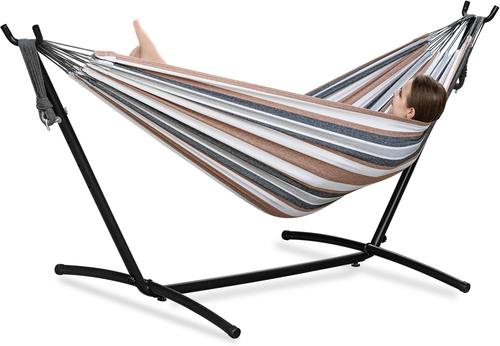
PNAEUT Double Hammock with Stand for Outside, Heavy-Duty, Portable (Coffee)
Hammock and frame in one purchase, so you never need a tree, a strap, or a lesson in hang angle
The stand anchors it to one address, and this is not a hammock that travels in a pack
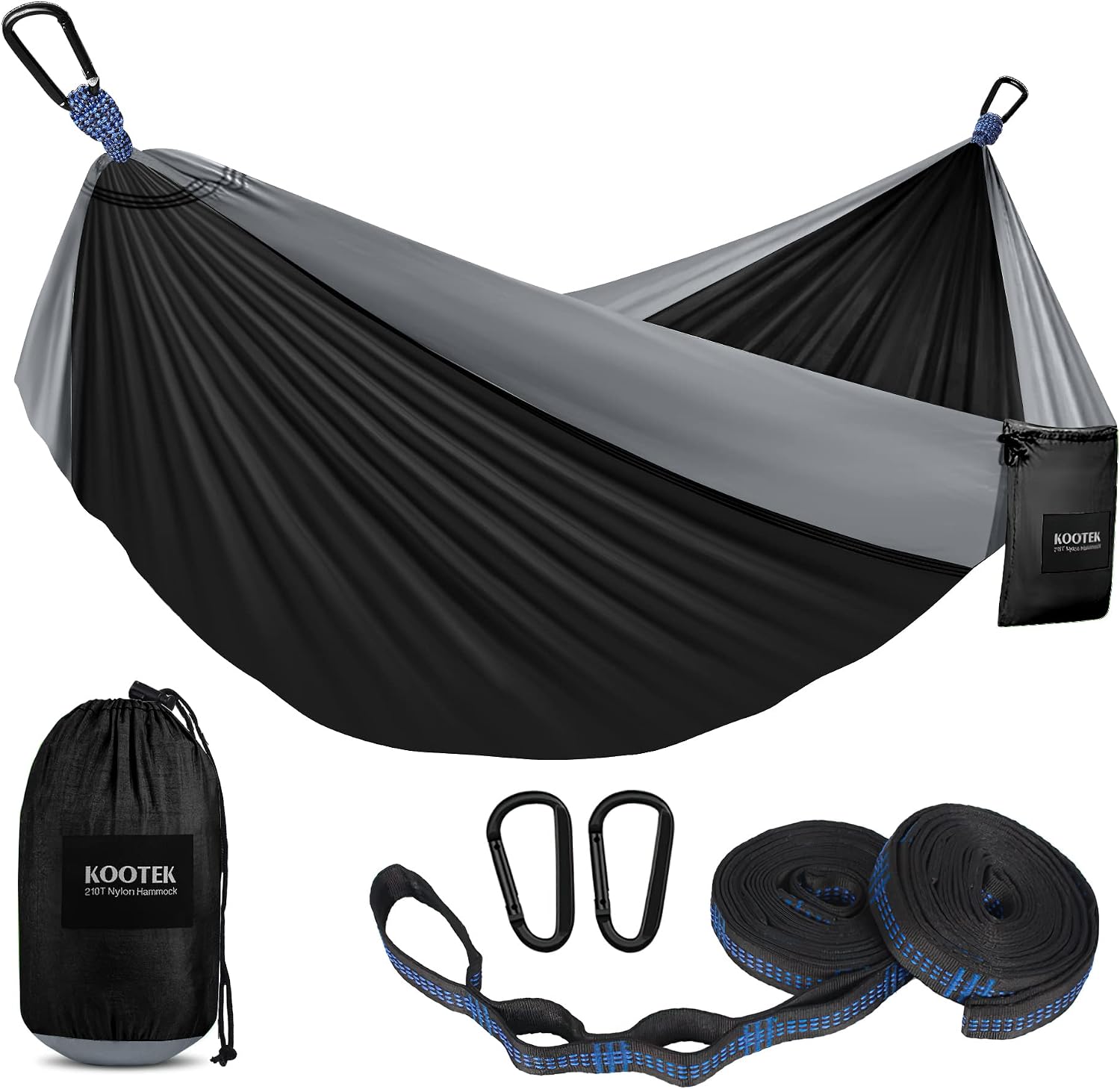
Kootek Camping Hammock 500lbs Capacity Outdoor Camping Essentials, Double
A stated 500 lb capacity in a double cut, aimed squarely at camping rather than the patio
Built around the hammock itself, so suspension and weather coverage are your problem to solve
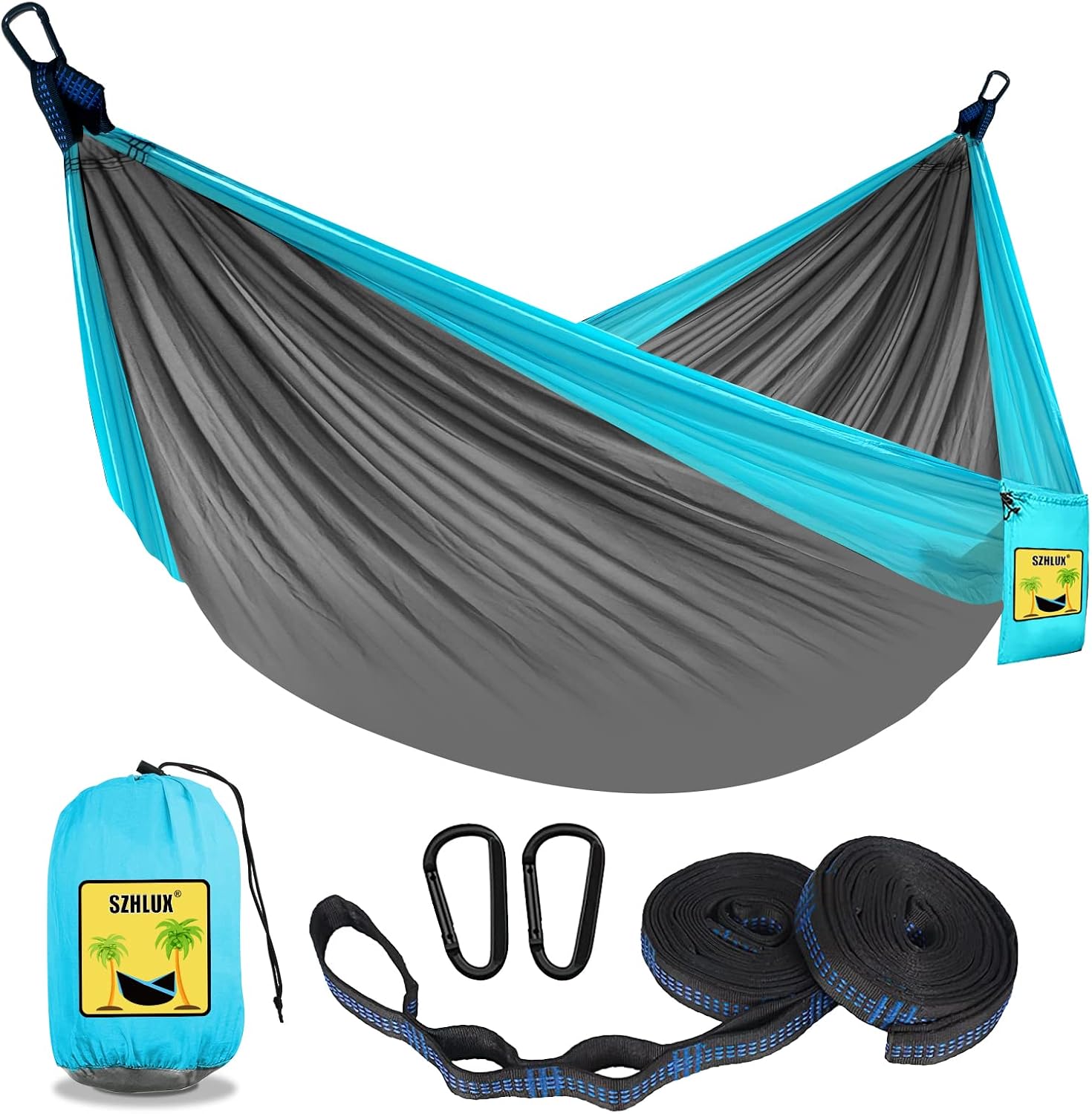
SZHLUX Camping Hammock Double and Single Portable Hammocks with 2 Tree Straps and Attached Carry Bag, Light Grey / Sky Blue
Two tree straps and an attached carry bag come in the box, making it the only complete hang of the four
Bundled straps are a starting point rather than a finish line, and there is no tarp or net in this setup
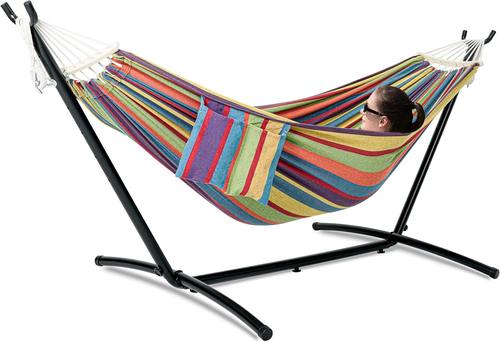
GAFETE Double Hammocks with Stand for Outside, Max 600lbs, (Classic Red)
The highest stated capacity in this group at 600 lb, in a classic red that is easy to spot across a yard
The same frame trade-off as any stand model: it lives wherever you assemble it
Prices and availability were captured from Amazon Creators API and may change.
How I judge a hammock before anything else
Show me the ridgeline first, then we can talk about fabric. That is not a slogan, it is the order of operations. A hammock is a geometry problem before it is a material problem. Hang it with roughly 30 degrees of sag and you sleep flat on your back or your side. Hang it tight like a banjo string and you get a shoulder squeeze that no premium fabric will ever fix. Hang it too loose and you fold up like a taco, wake with a numb arm, and blame the hammock for a mistake you made at setup.
So my evaluation order goes: hang angle, then suspension, then fabric, then everything else. Roughly nine out of ten complaints I hear about hammocks are hang-angle complaints wearing a fabric costume.
The second thing I check is the strap. Two-inch wide tree straps, every time. Rope, and I mean the thin cord that still ships in the box with a shocking number of cheap hammocks, concentrates your entire body weight into a strip narrow enough to cut bark. A forest ranger I know walked me through what a decade of rope damage looks like on a popular campsite tree, and I have not hung on rope since. That is not sentimentality. It is the same reason I will not hang from a dead branch, no matter how convenient it looks in the dark.
Third: does the fabric stretch overnight? Parachute nylon relaxes under a warm body, which means the hang you set up perfectly at 9 PM is two inches lower by midnight. Some of that is unavoidable, and all of it is manageable with a structural ridgeline, the cord that locks your sag so the hang does not change when the fabric gives. A hammock without one is a hammock you will re-adjust at 3 AM.
That is the test I grade on. Anyone can lie in a hammock for 20 minutes and declare it comfortable. The real question is whether you are still asleep at 3 AM when the temperature drops, the dew lands, and your body has been in the same position for six hours. A spec sheet cannot fake that result, which is why the sections below are about how each design hangs rather than about a feature list.
Stand hammocks: no trees, no knots, no learning curve
Two of the four products here are frame systems, and the case for them is straightforward to the point of being boring: they remove every variable that ruins a first hammock experience.
The PNAEUT Double Hammock with Stand for Outside is the complete package version. It is described as heavy-duty and portable in a coffee colorway, and what that combination buys you is a hang that works on a concrete patio, a deck, a balcony, or a driveway with no trees anywhere in sight. There is no 30-degree angle to eyeball, no strap width to worry about, no tree to damage, and no ranger asking why you are tied to a sapling in a public park.
The GAFETE Double Hammocks with Stand for Outside takes the same idea and pushes the stated capacity to 600 lb, in a classic red that reads clean in photos and is easy to find from the kitchen window. If two adults are going to use this regularly, or if you want the larger margin on paper, this is the one of the pair that makes that argument.
Now the honest part. A stand hammock is furniture, not gear. It gets assembled once and then it lives somewhere, which is exactly what you want on a Sunday afternoon and exactly what you do not want if you are sleeping in a tent site three miles from a trailhead. Portable here means movable around the property, not packable. It also means you need a flat-ish surface and somewhere to put the frame in January, because steel frames take up floor space and nobody plans for that in June.
The color choice matters more than people expect. Coffee hides dirt, pollen, and the general grime of a backyard. Red shows sun fade earlier but stays visible. Either way, bring the fabric in when you are not using it. Leaving any hammock body out through a season of UV and rain is how people end up replacing a hammock they liked.
Tree hammocks: the ones that actually leave the yard
The other two products are the ones that fit in a bag, and this is where hammock camping gets real.
The Kootek Camping Hammock leads with a stated 500 lb capacity in a double cut and is positioned as outdoor camping essentials. That capacity number is the headline, and it is a meaningful one when you are comparing against cheap hammocks that flex and creak under a single adult. This is the option for someone whose priority is a wide, roomy hammock body for camp and who is comfortable assembling the rest of the system around it.
The SZHLUX Camping Hammock is the one that shows up complete. It is listed as a double and single portable hammock with two tree straps and an attached carry bag, in light grey and sky blue, for outdoor, indoor, beach, and camping use. Two things in that description do a lot of quiet work. The attached carry bag means the sack cannot walk off separately from the hammock, which sounds trivial until you own four hammocks and can only find three bags. And the included tree straps mean the first thing you need after opening the box is two trees, not another order.
The caveat on any bundled suspension: included straps are a starting point, not a destination. Check the width, check them for wear every season, and plan to upgrade to a dedicated two-inch strap set at some point. That upgrade costs less than a dinner out and it is the single biggest safety and tree-protection improvement you can make to a travel hammock. Same reasoning applies to the light colors here. Pale fabric is lovely for a beach afternoon and unforgiving about mud, sap, and campfire ash.
Suspension is where cheap hammocks lose
Everyone compares fabric. Almost nobody compares what the fabric hangs from, and that is backwards.
Straps do three jobs at once. They spread your weight across the bark so the tree survives it, they hold the load so you survive it, and they set the geometry of your hang. A two-inch strap wrapped twice around a healthy trunk does all three. A thin cord wrapped twice does one of them badly. If your hammock came with rope, the rope is a tell about the rest of the kit.
The SZHLUX camping hammock is the only one of the four that includes tree straps in the box, which is why it gets the nod for a first camping hammock. For the two frame models, the strap conversation simply does not apply, and that is genuinely the appeal. There is no tree damage question on a patio, and no hang angle to get wrong when the frame was engineered to hold a specific hang.
For the two travel models, the straps are the beginning of a system, not a system. Add a structural ridgeline, learn what 30 degrees looks like with your hand span, and you will sleep flatter than most people who spent twice as much.
The trade-offs the product pages skip
- Weight and transport. Frame hammocks are car camping or backyard only. Nobody carries a stand to a backcountry site, and the "portable" language means portable within a property.
- Storage. Frames take floor space in a garage or shed through the off season. Hammock bodies fold into a bag the size of a loaf of bread.
- Site requirements. A tree hammock needs two healthy trees at roughly the right distance, plus land that permits hanging. A stand hammock needs flat ground and nothing else.
- Weather. None of these four is described as including a rain fly or a bug net. For camping, budget for coverage separately, and understand that a bug net and a tarp are not accessories. They are the difference between camping and surviving.
- Capacity versus comfort. A 500 lb or 600 lb rating is a ceiling, not a promise. Two adults in a "double" is a negotiation about who gets the middle, and the honest truth is that most double hammocks sized for two people who like each other will still sleep one person better.
- Double sizing. Some "double" hammocks are sized for one adult with room for a book. Read the width, not the label.
Which one is right for you
You have no trees and you want a nap spot that is ready in five minutes. The PNAEUT, because it arrives as one complete answer to the problem.
Two adults, or you want the highest stated capacity in this group. The GAFETE, for the 600 lb rating and a red that stays easy to spot.
You are camping, and you want one box to open before you sleep. The SZHLUX, because the tree straps and the attached carry bag are already in it.
You want a wide, high-capacity hammock body for camp and you will build the rest of the system yourself. The Kootek, with the 500 lb capacity as the starting point.
If you are between the two families and you genuinely do both, buy the stand first and the travel hammock second. The stand gets used more often than people expect, and the camping hammock is the one you can add later without regretting the earlier purchase.
What I'm testing next
The 2026 round of the 3 AM comfort test is already running: 10 units, two nights each, scoring whether I actually slept through instead of waking up to fiddle with sag. The four hammocks here are the ones I get asked about most, and the pattern in the questions has not changed in five years. People buy the wrong category, then blame the hammock.
Get the category right first. If it lives in one place, buy the frame. If it goes in a pack, buy the fabric and take the straps seriously. Everything after that is a geometry problem, and geometry is the part you control.